

Glossary
This glossary defines in one or two sentences the terms a service SMB owner runs into: Google and AI visibility (SEO, AEO, GEO, llms.txt), management (CRM, ERP, KPI, revenue), artificial intelligence (AI agent, LLM) and Quebec obligations (Law 25, CASL).
30 days free, no credit card.
All terms
- 301 redirect
- A 301 redirect is an HTTP “Moved Permanently” response saying a resource has moved for good to the address given in the Location header. Browsers follow the new address automatically, and Google treats the target as the version to show in its results. It is the standard tool for a site redesign or a domain change.
- 404 error
- A 404 (Not Found) error is an HTTP response code meaning the server can't find the requested resource. It usually follows a mistyped address or a page moved without a redirect. Google doesn't index URLs that return 404 and gradually drops those it had indexed; for visitors, it is a dead end you should make useful.
- Accounts receivable
- Accounts receivable are the amounts customers owe a business for services delivered or goods sold on credit, due within the normal operating cycle. They appear as a current asset on the balance sheet. Tracking them by age, and by how many days customers take to pay, shows how much of your earned revenue is still sitting outside your bank account.
- AEO
- AEO (Answer Engine Optimization) is a way of writing and structuring pages so that content gets reused as a direct answer: a featured snippet, a “People also ask” box, a voice assistant reply or an AI-generated answer. It is not an official Google term; it is an extension of ordinary search optimization.
- AI agent
- An AI agent is an artificial intelligence system that pursues a goal by choosing and chaining its own steps: it consults sources, uses tools, checks the result of each action and adjusts the next one. Unlike a simple text generator, it can act on other systems, which is why limits and human oversight matter so much.
- AI hallucination
- An AI hallucination is incorrect, inappropriate or fictitious content generated by an artificial intelligence model and presented as fact, as if it were genuine or matched the request. It stems from how generative models work: they predict plausible text without checking whether it is true, and they often sound confident either way.
- AI Overviews
- AI Overviews are AI-generated summaries that Google shows at the top of some results to explain a complex topic, along with links to web pages. To be included, a page has to be indexed and eligible to appear with a snippet; Google says no special optimization or extra technical requirement is needed.
- AI receptionist
- An AI receptionist is a conversational agent, by voice or text, that answers a business's calls and messages: it understands the request, asks the right questions, gives basic information and offers an appointment or hands off to a person. Current versions are usually built on a large language model connected to the business's own information.
- Alt text
- Alt text is the value of an HTML image's alt attribute (<img alt="…">). It tells people who can't see the image, including screen-reader users, what the picture contributes to the page, and it helps Google understand the image. A purely decorative image gets an empty alt attribute rather than a description or no attribute at all.
- API
- An API, or application programming interface, is a set of features and rules that a piece of software exposes so another program can interact with it automatically, without going through a person's screen. It works like a contract: you know what you can ask for, in what format, and what you will get back.
- Backlink
- A backlink, or inbound link, is a link on another website that points to a page on your site. Search engines use backlinks to discover pages and as one sign of how well known a business is. Google's spam policies forbid links bought or built to manipulate rankings.
- BI (business intelligence)
- Business intelligence (BI) is the use of computing tools to collect, consolidate and analyse an organization's raw data in order to guide strategic decisions. It covers dashboards, analysis reports and predictive models. In French, Quebec's terminology office prefers informatique décisionnelle and discourages the literal translation intelligence d'affaires.
- Bing Webmaster Tools
- Bing Webmaster Tools is Microsoft's free service that lets a site owner check how Bing crawls and indexes the site, track impressions, clicks and positions, submit a sitemap and, since 2026, see how often its pages are cited in Microsoft's AI-generated answers such as Copilot. Sites already verified in Google Search Console can be imported.
- Break-even point
- The break-even point is the level of sales at which a business's revenue exactly covers all its costs, fixed and variable. Profit there is zero: below it you operate at a loss, above it you earn an operating profit. For most small businesses it is calculated by dividing overhead, the indirect costs, by the gross margin percentage.
- Canonical tag
- A canonical tag is a link rel=canonical element in a page's head that names the URL you want shown in search results when several URLs serve the same or very similar content. Google treats it as a strong signal rather than a command, so it can still pick a different version.
- Cash flow
- Cash flow is the movement of money into and out of a business over a period. When more cash comes in than goes out, cash flow is positive; when the reverse happens, it is negative. Unlike profit, it follows money actually received and actually paid, at the moment it moves, which is why the two can tell very different stories.
- CASL (Canada's anti-spam legislation)
- CASL, Canada's anti-spam legislation (LCAP in French), is the federal law that prohibits sending commercial electronic messages without the recipient's express or implied consent. Each message must also identify the sender, give a way to contact them and include a simple, free unsubscribe mechanism.
- Churn rate
- Churn rate is the share of customers on a contract or subscription who cancel or fail to renew during a given period. The basic version divides customers lost by customers at the start of the period. It can also be measured in lost recurring revenue instead of a headcount, which shows the financial weight of departures.
- Click-through rate (CTR)
- Click-through rate, or CTR, is the number of clicks divided by the number of impressions, shown as a percentage. In organic search it measures the share of people who saw your listing on Google and then clicked it. Five clicks from 100 impressions, for instance, is a 5% CTR. It says nothing about what visitors do once they land.
- CLS
- Cumulative Layout Shift (CLS) is a score for a page's visual stability: it adds up unexpected movements of visible content during the worst burst of shifts in the page's life. Web.dev rates a CLS of 0.1 or less as good and anything above 0.25 as poor, at the 75th percentile of visits.
- CNESST
- The CNESST (Commission des normes, de l'équité, de la santé et de la sécurité du travail) is the Quebec public body that promotes and enforces workplace rights and obligations. It covers labour standards, pay equity and occupational health and safety, and runs the mandatory insurance plan for workplace accidents and occupational diseases.
- Content Security Policy (CSP)
- A Content Security Policy (CSP) is a set of instructions a website sends to the browser, usually in the Content-Security-Policy HTTP header, restricting which resources a page may load and what it may do. Its main purpose is to limit the damage from cross-site scripting (XSS) injection and from clickjacking attempts.
- Conversion rate
- A conversion rate is the percentage of people who complete a target action out of everyone who had the chance to: submitting a form, booking, or accepting a quote. You calculate it by dividing conversions by opportunities, such as visits, clicks or requests, over the same period and multiplying by 100.
- Cookie consent
- A cookie is a small piece of data a website stores in the browser to remember a session, a preference or a behaviour. In Quebec, cookies that let a business identify, locate or profile someone must be disclosed beforehand and stay switched off until the person turns them on. Strictly functional cookies are simply explained in the privacy policy.
- Core Web Vitals
- Core Web Vitals are three metrics Google uses to describe real-world page experience: Largest Contentful Paint for loading, Interaction to Next Paint for responsiveness and Cumulative Layout Shift for visual stability. A page meets the bar when each one hits the good threshold at the 75th percentile of visits.
- CRM
- CRM, or customer relationship management, is the set of actions an organization takes to attract new customers and keep existing ones. In everyday use, CRM also means the software that brings contacts, past conversations, quotes and follow-up tasks together in one place, so the whole team sees the same customer history.
- CRP
- CRP is an acronym occasionally used for customer relationship management, meaning the practices and software a business uses to win and keep customers. It is rare in Quebec, where people say CRM in English and GRC in French. In production management, CRP usually stands for capacity requirements planning instead.
- Customer acquisition cost (CAC)
- Customer acquisition cost (CAC) is the average amount a business spends to win one new customer over a given period. You add up marketing and sales spending, including staff time, and divide it by the number of new customers gained. It is not the same as the cost per conversion shown in ad platforms.
- Customer lifetime value (LTV)
- Customer lifetime value (LTV or CLV) is the revenue, or better the gross margin, a customer brings a business over the whole relationship. A simple estimate multiplies the average purchase value by purchases per year and by the number of years the customer stays. It is usually read side by side with acquisition cost.
- Customer retention rate
- Customer retention rate is the percentage of customers you had at the start of a period who are still doing business with you at the end of it. You calculate it by taking the customer count at the end, removing the new customers gained during the period, and dividing by the count you started with.
- Dashboard
- A management dashboard is a visual display of the indicators an owner or manager needs to track the business and make timely decisions toward set objectives. It is more condensed than an operating report: a few figures, ratios or charts chosen for one person's decisions, with thresholds that flag problems early.
- Demand forecasting
- Demand forecasting is putting a number on how much work customers will ask for during a future period, such as a week or a season. It projects past data forward and factors in known drivers, like the calendar or the weather, so you can plan staff, equipment and purchases before the requests arrive.
- Dispatch
- Dispatch is the process of assigning incoming service requests to available technicians or crews, based on their schedules, workload, skills and location. A dispatcher decides who goes where, when and in what order, and records that decision so the job, the customer and the technician all stay in sync.
- Double opt-in (confirmed opt-in)
- Double opt-in is a two-step subscription method: the person signs up on a form, then confirms by clicking a link sent to their inbox. The address joins the list only after that confirmation. No law we reviewed requires it, but it shows that the address really belongs to the person who consented, which helps when you must prove consent.
- E-E-A-T
- E-E-A-T stands for experience, expertise, authoritativeness and trustworthiness. Google uses these four ideas to describe what makes content reliable. Trust is the most important of the four, and Google says E-E-A-T is not itself a specific ranking factor, even though its systems look for signals that point to it.
- ERP
- An ERP (enterprise resource planning) system is a software package that manages a company's processes by integrating all of its functions: accounting and finance, human resources, purchasing, sales, distribution and decision support. Because every function shares the same data, information entered once is reused everywhere instead of being typed in again.
- Express and implied consent
- Express consent is given through a clear action by the person: ticking an empty box, signing, saying yes. Implied consent is inferred from a situation, such as a recent purchase, without an explicit yes. Under CASL, express consent lasts until withdrawn, while implied consent is generally time-limited. Privacy laws use the same pair of terms with different rules.
- Featured snippet
- A featured snippet is a special Google box that flips the usual result layout: it shows a passage answering the search first, followed by the title and link of the page it came from. Google alone decides which pages appear there, and no markup lets a site request or reserve that spot for itself.
- First-party data
- First-party data is information a business collects itself from its own customers and visitors: forms, booking history, purchases, service conversations. It contrasts with third-party data, gathered by someone else and then shared or sold. It isn't a legal category; once it identifies a person, it is personal information and privacy law applies in full.
- GEO
- GEO (Generative Engine Optimization) is a set of practices meant to make content visible in answers written by generative engines, the tools that pull several sources together and summarize them with a large language model. The term comes from a 2023 research paper, not from a standard body or from Google.
- Google Analytics 4 (GA4)
- Google Analytics 4 (GA4) is the current version of Google's audience-measurement tool. It collects event-based rather than session-based data from websites and apps: page loads, clicks, form submissions and more. It replaced Universal Analytics, whose standard properties stopped processing data on July 1, 2023, and it now handles both websites and apps.
- Google Business Profile
- A Google Business Profile is the free listing that presents a business in Google Search and Google Maps: name, category, contact details, hours, service area, photos and reviews. Google ranks these listings mainly on relevance, distance and prominence, and there is no way to pay for a better local ranking.
- Google Search Console
- Google Search Console is a free Google service that lets a site owner confirm Google can crawl and index the site, see which queries it appears for along with clicks and impressions, and get alerts when something goes wrong. Signing up isn't required to appear in Google Search, but it shows you how Google sees your site.
- Gross margin
- Gross margin is what remains of a sale, or of a period's revenue, once you subtract the direct costs of delivering it: materials, the labour that does the work and other job-specific costs. In dollars it is usually called gross profit; as a percentage of revenue it is the gross margin ratio that owners compare month to month.
- GST and QST
- GST is the federal goods and services tax, charged at 5%; QST is the Quebec sales tax, charged at 9.975%. A registered business adds both to its taxable sales, collects them on behalf of the two governments and remits them, minus the tax it paid on its own business purchases, for each reporting period.
- hreflang
- hreflang is an annotation that tells Google about other language or regional versions of the same page, such as en-CA and fr-CA. Every version has to list itself and all the others; if two pages do not point to each other, Google may ignore the annotations altogether.
- HTTPS and HSTS
- HTTPS is the encrypted version of the web protocol: traffic between the browser and your site travels over a secure connection. HSTS (HTTP Strict Transport Security) is a Strict-Transport-Security response header telling browsers to use only HTTPS for that domain for a set period, and to refuse any click-through on certificate errors.
- Human-in-the-loop (human approval)
- Human-in-the-loop is a way of designing an automated system or AI agent so that a person authorizes, corrects or rejects an action before it is carried out. It matters most for sensitive actions: writing to a customer, spending money, changing an official record or making a decision about someone.
- Impressions (Search Console)
- In Google Search Console, an impression is counted each time a link to your site appears in a set of Google results a person loads, even if they never scroll down to it. In carousels and expandable sections the link generally has to be displayed. Impressions are the denominator of click-through rate.
- IndexNow
- IndexNow is an open protocol that lets a website instantly notify participating search engines that a URL was added, updated or deleted. The site publishes a verification key, then sends the list of affected URLs. Submitting speeds up discovery, but it does not guarantee that a page will be indexed.
- Information system (IS)
- An information system (IS) is a structured set of hardware, software and human resources that lets an organization collect, store, process and share information. It is broader than the computer system alone: the people, the rules they follow and even paper forms are part of it, because they shape how information actually flows.
- INP
- Interaction to Next Paint (INP) is a Google metric that assesses how responsive a page is overall: the delay between a click, tap or key press and the next visual update on screen. An INP of 200 milliseconds or less counts as good, while anything above 500 milliseconds is poor.
- Internal linking
- Internal linking is the set of links that connect pages within the same website, such as a service page linking to the FAQ or a town page linking back to the service offered there. It helps visitors move around and lets Google discover pages and understand what they cover through the link text.
- Keyword cannibalization
- Keyword cannibalization happens when several pages on the same site target the same query and the same intent. Signals such as links, clicks and impressions get spread across those pages, and the search engine may show a version you wouldn't have picked, or swap between them. The fix is to merge, redirect or genuinely differentiate the pages.
- KPI (key performance indicator)
- A KPI, or key performance indicator, is a quantitative or qualitative measure used to assess how well an organization is performing against its strategic objectives. That means a KPI always starts from a goal, and comes with a formula, a data source, a time period and a target, so everyone calculates it the same way.
- Large language model (LLM)
- A large language model (LLM) is a very large language model trained on huge collections of general text and designed to handle a wide range of language tasks: drafting, summarizing, translating and reasoning. It writes by predicting, piece by piece, the most likely continuation of the text it has been given, which is usually right but not always.
- LCP
- Largest Contentful Paint (LCP) is the time from the start of navigation until the largest image, text block or video in the visible part of the screen is rendered. Web.dev rates an LCP of 2.5 seconds or less as good, and anything above 4 seconds as poor, measured at the 75th percentile of visits.
- Live chat (website chat)
- Live chat is a written, interactive, real-time conversation between internet users, typically between a website visitor and a business in a chat window on the site. It can be staffed by people, handled by a chatbot, or both. Whatever the visitor types, such as a name or address, is usually personal information that privacy law covers.
- llms.txt
- llms.txt is a Markdown text file placed at the root of a website (/llms.txt) that briefly introduces the business and lists its most useful pages, so large language models can find their way quickly. It is an open proposal from 2024 rather than an official standard, and it sits alongside robots.txt and the sitemap.
- Local SEO
- Local SEO is the part of search engine optimization that targets location-based searches such as “electrician in Laval”. It relies on a Google Business Profile, consistent contact details, genuine customer reviews and website pages that clearly name the areas the business serves, so nearby people can find and call it.
- Long-tail keyword
- A long-tail keyword is a long, specific search query, often four words or more, that few people type individually but that, added up with hundreds of similar queries, accounts for a large share of searches. It usually spells out a clear need, such as a service, a place and a constraint, which makes it easier to answer precisely.
- Meta description
- A meta description is an HTML <meta name="description"> tag that offers a short summary of a page. Google may show it as the snippet under the title link when it describes the page better than text pulled from the page itself. It is invisible on the site; its job is to persuade a searcher to click through.
- MRR and ARR (monthly and annual recurring revenue)
- MRR, monthly recurring revenue, is the total of all active subscriptions and service plans expressed as a monthly amount, before tax. ARR, annual recurring revenue, is the yearly equivalent, usually MRR multiplied by 12. Neither includes one-time sales such as installations or repairs, even from regular customers.
- NAP
- NAP stands for the name, address and phone number of a business. NAP consistency means showing exactly the same three details on your website, Google Business Profile, social media, directories and paperwork, so that customers and search engines recognize one single business rather than several conflicting versions.
- NEQ (Québec enterprise number)
- The NEQ, or Québec enterprise number, is a ten-digit identifier that the Registraire des entreprises assigns to every enterprise registered in Quebec's enterprise register. The business uses it to identify itself with Quebec departments and agencies, and anyone can look the business up by its NEQ, free of charge, in the public register.
- Newsletter (email newsletter)
- An email newsletter is a message sent periodically to subscribers with short updates on chosen topics: tips, news, offers. In Canada it is usually a commercial electronic message under CASL, so it needs the recipient's express or implied consent, sender identification, contact details and a working unsubscribe link in every single issue.
- No-show rate
- A no-show rate is the share of confirmed appointments where the customer neither shows up nor cancels in advance. You calculate it by dividing missed appointments by appointments scheduled over a set period, then multiplying by 100. It tells a service business how much booked capacity goes unused.
- OAuth
- OAuth 2.0 is an authorization framework standardized by the IETF that lets a third-party application get limited access to a web service on its owner's behalf, without ever learning the owner's password. The person approves the access once, and the application receives a token restricted to specific scopes that can be revoked at any time.
- Omnichannel customer service
- Omnichannel customer service ties every channel a customer uses to reach the business, whether phone, email, text, web form, social media or front counter, into a single customer record. The conversation carries on from one channel to another without the customer repeating everything, and staff see the full history before they reply.
- Online booking
- Online booking is a service that lets customers reserve a time themselves, through a web page or a button on a business listing, from availability calculated against staff calendars. The appointment is recorded without a phone call, then confirmed, rescheduled or cancelled according to the business's rules. It is also called online scheduling or self-booking.
- Open Graph
- Open Graph is a protocol of <meta property="og:…"> tags placed in a page's head to describe how the page should look when shared. Originally created at Facebook, it is read by LinkedIn, chat tools such as Slack and other services to build the link preview: title, image, description and the page's reference URL.
- People Also Ask
- People Also Ask is a Google results-page box that groups questions related to the original search. When someone expands a question, Google shows a featured snippet taken from a web page, with a link to it. Site owners can't control which questions appear in the box or which pages answer them.
- Personal information (personal data)
- Under Quebec law, personal information is any information that relates to a natural person and directly or indirectly allows that person to be identified: name, address and phone number, but also a technician's service note or an account ID. Federal law uses a similar test: any information about an identifiable individual, factual or subjective, recorded or not.
- Pillar page
- A pillar page is an in-depth page that presents a broad topic as a whole, such as “Residential heat pumps”, and uses internal links to send readers to more detailed pages on each subtopic, which link back to it. The term comes from content marketing; Google gives it no official definition, but it rests on principles Google describes.
- Privacy impact assessment (PIA)
- A privacy impact assessment (PIA) is an analysis a business carries out before a project that involves personal information, to spot privacy risks and plan measures to reduce them. In Quebec it is mandatory before acquiring, developing or overhauling an information system, and before communicating personal information outside Quebec, among other situations.
- Privacy officer (person in charge of personal information)
- In Quebec, the person in charge of the protection of personal information, often called the privacy officer, makes sure a business complies with the private-sector privacy Act. By default it's the person with the highest authority, who may delegate the role in writing. The officer's title and contact information must be published on the business's website.
- Process automation (RPA vs workflow)
- Process automation means handing a sequence of repetitive tasks that a person used to do by hand over to software. It comes in two main forms: workflows, which connect applications through rules and APIs, and robotic process automation (RPA), where a software robot mimics a user's clicks and keystrokes on screen.
- Quebec Law 25 (privacy)
- Law 25 is the Quebec statute adopted in 2021 that modernized privacy rules, including the Act respecting the protection of personal information in the private sector. It requires businesses to have a person in charge of personal information, obtain clear consent, report serious confidentiality incidents and be more transparent about what they collect.
- Quote (soumission)
- A quote is a written offer in which a business describes the work or services it proposes to provide and the price it asks. In Quebec French it is called a soumission, a word used both for answering a formal call for tenders and for the estimate given to a homeowner.
- RBQ licence
- An RBQ licence is the authorization issued by the Régie du bâtiment du Québec to anyone who carries out construction work, or has it carried out, unless the law exempts them. It is required as soon as a contractor bids or advertises, and its 10-digit number must appear on quotes, invoices, ads, vehicles and websites.
- Recurring billing
- Recurring billing means automatically charging a customer at a regular interval, weekly, monthly or yearly, for an ongoing service or plan under terms agreed once up front. Payment is usually taken by credit card or pre-authorized debit, so the customer doesn't have to do anything each period unless a payment fails or the plan changes.
- Resource allocation
- Resource allocation means assigning an organization's human, material or financial resources to the work that has to be done to reach a goal. In a small service business, it comes down to deciding which people, which vehicles, which equipment and how many hours go to each contract, week after week.
- Revenue (sales)
- Revenue, also called sales or turnover, is the total of a business's sales of goods and services over a given period. Revenue that includes recoverable taxes is called gross; revenue that excludes them is net, which is what the income statement shows unless stated otherwise. Revenue measures activity, not profit, since no expenses are deducted.
- Robots meta noindex
- Noindex is a rule for search engines, delivered either by a <meta name="robots" content="noindex"> tag or by an X-Robots-Tag HTTP header. When Googlebot sees it on a crawl, Google drops the page from its results even if other sites link to it. The page itself stays online for anyone who has the address.
- robots.txt
- robots.txt is a plain text file at the root of a website, at the address /robots.txt, that tells crawlers which URLs they are allowed to fetch. Its main job is to keep crawlers from overloading your server. It does not hide pages from Google and does not secure anything.
- Route optimization
- Route optimization is planning each vehicle's itinerary to set the order of customer visits or pickups at the lowest cost in distance or time. It has to respect real-world constraints: arrival windows promised to customers, vehicle capacity, how long each job takes and the hours each crew can work.
- SaaS
- SaaS, or software as a service, is standard software hosted on a provider's servers and used over the internet, usually for a subscription. The customer installs nothing and does not manage servers, storage or updates; it only controls a limited set of settings for its own users and decides what data goes in.
- Search intent
- Search intent is the goal behind a query: learning something, getting a task done, reaching a particular website or finding a place to visit. Search engines try to infer it before ranking results, so a page that serves that goal directly stands a better chance of being judged useful than one that merely repeats the query's words.
- SEO
- SEO (search engine optimization) is the work of making a website easier for search engines to find, understand and show in their unpaid results. It covers three areas: the technical health of the site, the usefulness of each page, and the signals that tell a search engine your business can be trusted.
- SERP
- A SERP (search engine results page) is the page Google, Bing or another engine shows after someone runs a query. It blends text results, rich results, images, videos, ads and exploration features. Its layout shifts with the device, the country, the query language and the query itself, so no two SERPs are guaranteed to match.
- Service capacity
- Service capacity is the amount of work a service business can deliver to customers over a period, measured in billable hours or in jobs. It starts from paid hours, minus travel, internal tasks and absences; the utilization rate then compares the work actually sold to that capacity. In manufacturing, the same idea is called production capacity.
- SME (PME)
- An SME, or small and medium-sized enterprise, is a business of limited size, usually defined by its number of employees. Innovation, Science and Economic Development Canada defines SMEs as businesses with 1 to 499 paid employees, while Quebec's language office describes a PME as having fewer than 250 employees.
- Structured data (schema.org, JSON-LD)
- Structured data is a standardized format that describes a page's content to search engines: business type, address, hours, questions and answers. Sites usually use the schema.org vocabulary, most often written in JSON-LD, the format Google recommends when a site's setup allows it. Valid markup never guarantees a rich result.
- Time slot
- A time slot is a specific block of time, with a start and an end, during which a person or resource can deliver a service. In a booking tool, slots are carved out of availability according to the service length, buffers and existing appointments; once a customer reserves a slot, it becomes an appointment and disappears from the list.
- Title tag
- A title tag is the HTML <title> element in a page's head section that gives the document its name. Browsers show it on the tab, screen readers announce it first, and Google uses it as the main source for the blue clickable headline in search results. Every page should have one that is unique and descriptive.
- Topic cluster
- A topic cluster is a group of pages that each cover a different angle of one broad subject, linked to one another and to a pillar page that presents the whole. It helps you plan content from customers' real questions, avoid duplicate pages and make your coverage of a subject easy to read for both people and search engines.
- UTM parameters (campaign tags)
- UTM parameters are tags added to the end of a web address (after the “?”) that tell an analytics tool such as Google Analytics where a visitor came from: the source (newsletter, Facebook), the medium (email, social post) and the campaign. They don't change the page people see; they exist only for measurement.
- Virtual receptionist
- A virtual receptionist is a phone answering service delivered remotely: a person at an outside firm, or an automated system, answers in the company's name, takes messages, transfers calls or books appointments. It is a broad concept, and an AI receptionist is only one of its forms.
- Webhook
- A webhook is a mechanism in which a piece of software automatically sends an HTTP request carrying data to a web address you chose, as soon as a specific event occurs, such as a payment going through or a booking being created. The receiving system therefore does not need to keep checking the source system for changes.
- Work order
- A work order is a document that sets out how a job is to be carried out: what to do, where, with which tools and by when. In a service business, it links the quote the customer accepted, the technician who was dispatched and the final invoice, and it records the hours and materials actually used.
- Workforce planning
- Workforce planning means estimating the staff a period will need (headcount, skills and hours), comparing that with the people you actually have, then deciding how to close the gap: schedules, overtime, hiring, training or subcontracting. In Quebec, every plan also has to respect the labour standards enforced by the CNESST, from notice periods to weekly rest.
- XML sitemap
- An XML sitemap is a file that gives search engines a list of a site's pages, videos and other files, along with details such as when each page was last modified. It helps crawlers find the pages you consider important, but it does not guarantee they will be crawled or indexed.
Your whole business, on one screen.
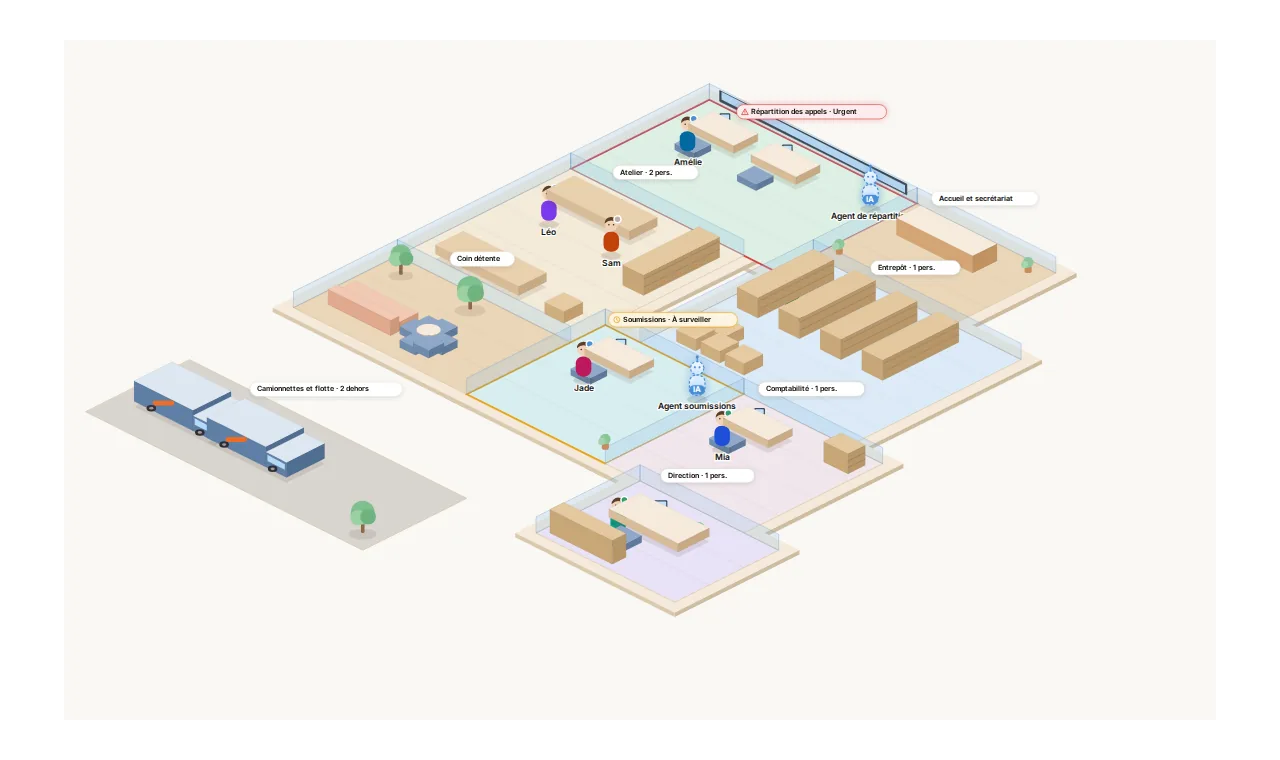
Each department is a room. Pilotiko prepares the work; you approve with one click.
- Call answered
- Appointment confirmed
- Email reply ready
- Invoice prepared