

Pilotiko feature : available
Resource allocation: how do you divide people, equipment and hours?
Before deciding who takes which call, you need to know how many hours, vehicles and machines you actually have to hand out.
Resource allocation means assigning an organization's human, material or financial resources to the work that has to be done to reach a goal. In a small service business, it comes down to deciding which people, which vehicles, which equipment and how many hours go to each contract, week after week.
30 days free, no credit card.
In short
- Quebec's OQLF treats allocation, affectation and répartition des ressources as equivalent French terms.
- You allocate people, but also vans, machines, budget and time.
- Quebec's 40-hour standard work week marks the point where hours get more expensive.
- Allocation is a weekly decision; dispatching calls is a daily one.
How is resource allocation defined?
Quebec's Grand dictionnaire terminologique defines resource allocation as assigning human, material or financial resources to reach a given objective within an organization. It notes that the concept usually comes up in budget planning or project management, and it lists three preferred French terms for the same idea: allocation, affectation and répartition des ressources [1].
It is broader than staffing, which the same dictionary describes as filling a vacant position or putting together work teams from an organization's existing staff [2]. Resource allocation also covers the cargo van, the floor scrubber, the rented boom lift and the subcontracting budget, not just the crew.
How is allocation different from dispatching?
Dispatching answers a narrow question: which technician takes the call that just came in. Allocation happens earlier. It sets how many people work on which kind of contract, which vehicles stay free for emergencies and which hours are held for recurring customers. Good dispatching cannot rescue poor allocation: if the whole crew is booked solid until Friday, the dispatcher has nobody left to send.
| Horizon | Question | Resources involved | Example |
|---|---|---|---|
| Year or season | How many people and vehicles do we need? | Hiring, purchases, rentals | Add a second crew for the summer |
| Week | Which crew on which contract, with which equipment? | Hours, vehicles, machines | Keep the floor scrubber for the office towers |
| Day | Who goes on this call, and in what order? | Time slots, travel | Send Louis to the 2 p.m. customer |
The first two horizons are allocation; the third is mostly dispatching and route sequencing.
How does software model an assignment problem?
In operations research, the classic assignment problem reads like this: a group of workers must carry out a set of tasks, each worker-task pair has a cost, each worker gets at most one task and no two workers do the same task; the goal is the lowest total cost. Google's OR-Tools documentation walks through a case with four workers and four tasks, where one possible assignment totals 70 + 55 + 95 + 45 = 265 [3].
In practice, the cost of a pairing is rarely just dollars. It can stand for driving time, a missing certification or a customer who prefers a particular person. The model still earns its keep because it forces you to write down exactly what you are trying to minimize.
Why does Quebec's 40-hour work week matter here?
In Quebec, the standard work week is 40 hours for most workers, and it is the point where overtime begins: someone who worked 45 hours in a week did 5 hours of overtime. The CNESST adds that the standard week is not a limit beyond which a person may refuse to work, and that some categories, such as guards employed by a security firm, have a different standard week [4].
For whoever allocates the work, that rule draws a bright line. Past 40 hours per person, every extra hour carries an overtime premium, so it pays to see the gap between hours requested and hours available on Monday morning rather than on the next payroll run.
What does a weekly allocation look like in numbers?
Which resource allocation mistakes should you avoid?
- Counting only people and forgetting equipment, when a van or a machine may be the real bottleneck.
- Booking 100% of hours on Monday, with no slack for emergencies or sick days.
- Always giving the toughest contracts to the same person, who burns out while others run short of hours.
- Deciding blind: without a dashboard of workload per person, the gap stays invisible.
- Changing the plan without telling the crew or updating the work order.
- Tracking a single KPI, such as today's revenue, instead of the balance between demand and capacity.
What does Pilotiko do for resource allocation?
In its scheduling module, available today, Pilotiko proposes who should take each booking based on everyone's calendar and workload, using real open time slots, and flags scheduling conflicts. Internal reports show workload per person and per room of the virtual office. A proposal stays a proposal: a person confirms it, in line with human approval.
Pilotiko does not yet sequence driving between jobs: route optimization is planned, not offered. It does not run payroll either.
Frequently asked questions
Is it resource allocation or resource assignment?
Both phrases are used in English, and in French the OQLF accepts allocation, affectation and répartition des ressources for the same idea. Pick one term and stick to it across your documents.
How is resource allocation different from workforce planning?
Workforce planning looks ahead to how many people, with which skills, you will need in the coming months. Allocation splits the resources you already have, people and equipment, across this period's work. One feeds the other.
How often should allocation be reviewed?
A weekly review suits most service businesses, with daily tweaks for emergencies. In peak season, a mid-week check helps you catch a gap before it turns into overtime.
How can I tell if my resources are underused?
Compare billable hours with available hours for each person and each vehicle. A low rate that persists points to a surplus; a rate that keeps exceeding normal capacity points to a shortage. Measure over several weeks rather than one.
Can software make the allocation decision on its own?
It can calculate a proposal from the calendar, the workload and the constraints you give it. What it cannot see, such as a recent injury or a difficult customer, calls for human judgment. Keep the final say with a person.
Sources
- Office québécois de la langue française, Grand dictionnaire terminologique, allocation des ressources (accessed on October 15, 2026).
- Office québécois de la langue française, Grand dictionnaire terminologique, affectation de personnel (accessed on October 15, 2026).
- Google for Developers, OR-Tools, Assignment (accessed on October 15, 2026).
- CNESST, Standard work week (accessed on October 15, 2026).
Read next
- Dispatch: how should service calls be assigned?Dispatch explained for field service companies: how calls get assigned to technicians, which criteria matter, a worked example from Laval and common mistakes.
- Work order: what should it include?What a work order is, what it should include, how it sits between the quote and the invoice, with a worked electrician example from Gatineau and common gaps.
- What is a management dashboard?What a management dashboard is, leading versus lagging indicators, how it differs from a report, a snow-removal example and mistakes that make it useless.
- What is a KPI (key performance indicator)?What a KPI is, how to derive one from a business goal, formulas for a service company, a worked month of numbers and the traps to avoid when picking them.
- What does human-in-the-loop mean?Human-in-the-loop puts a person before an AI's sensitive actions. Forms of oversight, Quebec and Canadian rules, a worked SME example and the mistakes to avoid.
- Workforce planning: how do you get the right people at the right time?Workforce planning for a Quebec service business: time horizons, CNESST scheduling rules, vacation timing and a peak-season calculation for a landscaper.
Your whole business, on one screen.
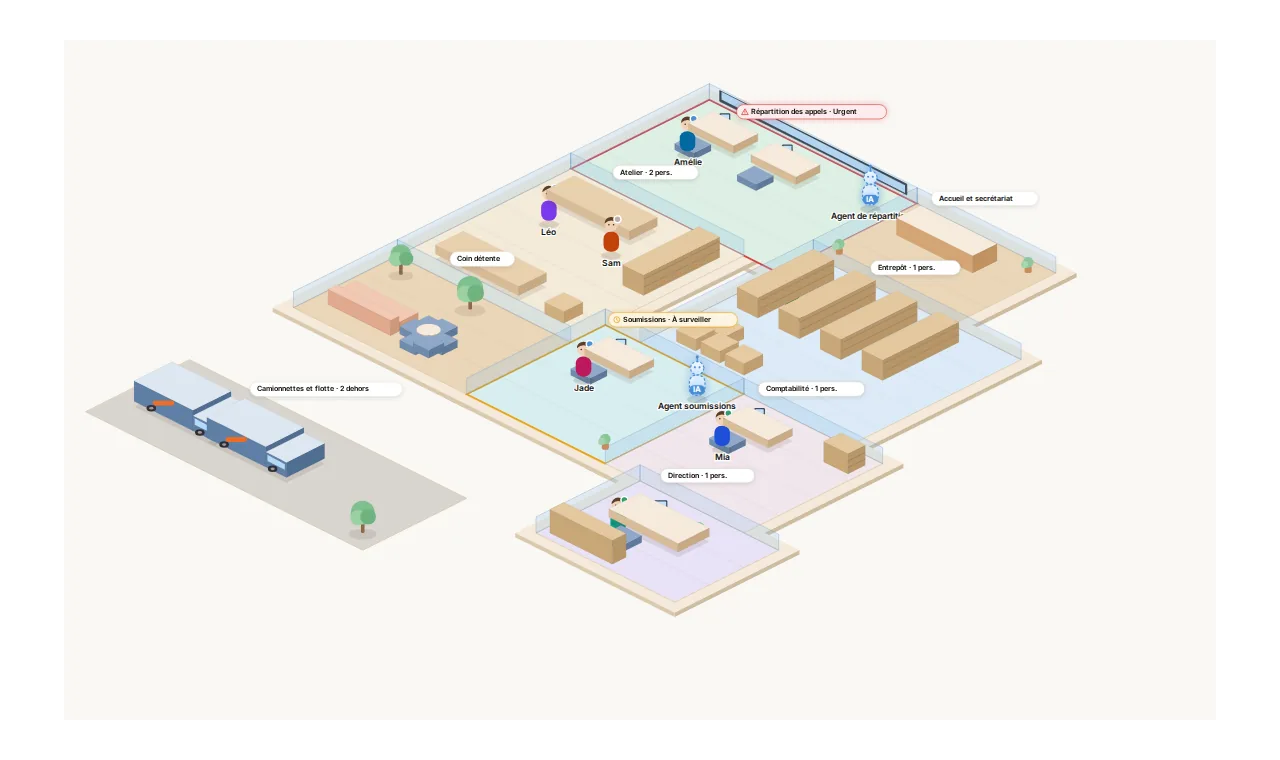
Each department is a room. Pilotiko prepares the work; you approve with one click.
- Call answered
- Appointment confirmed
- Email reply ready
- Invoice prepared