
Pilotiko feature : available
First-party data: which data is really yours?
Browsers keep closing the door on third-party cookies. That makes the data customers give you directly more valuable, and more of a responsibility.
First-party data is information a business collects itself from its own customers and visitors: forms, booking history, purchases, service conversations. It contrasts with third-party data, gathered by someone else and then shared or sold. It isn't a legal category; once it identifies a person, it is personal information and privacy law applies in full.
30 days free, no credit card.
In short
- First-party: you collected it. Third-party: someone else did, then shared or sold it.
- Firefox and Safari block cross-site cookie tracking by default; Chrome does not by default.
- In Quebec, commercial prospecting is not a “consistent purpose”, so it needs consent.
- Inferred data, such as a consumer profile, is still personal information.
Where does the first-party vs third-party split come from?
It started with cookies. MDN explains that a cookie is first-party when its domain and scheme match the page shown in the address bar, and third-party when they don't, for instance when an embedded ad widget sets its own [1]. The OPC describes the same history: cookies were first shared only between the site and the user, then advertising companies began setting their own and linking visits across sites [3]. Marketers later stretched the label to cover all data: what you gather yourself versus what comes from elsewhere.
MDN also sums up where browsers stand. Firefox isolates third-party cookies per site by default, Safari applies tracking prevention by default and Brave blocks tracking cookies, while Chrome doesn't block third-party cookies by default except in Incognito or when the user changes the setting [1]. The practical upshot for a business: what you know about your customers depends less on ad networks and more on your own records.
| Origin | Who collects it | Examples | Watch out for |
|---|---|---|---|
| First-party | Your business | Quote form, booking history, service notes | Purposes set before collecting |
| Second-party | A partner, who passes it to you | List shared after a joint event | Consent to the disclosure |
| Third-party | A broker or platform | Purchased audience segments | Source and consent often unverifiable |
Common marketing usage; the law instead talks about collecting from the person or from a third party.
What does Quebec law say about this data?
Quebec's private-sector privacy Act never says “first-party”, but its rules kick in as soon as data identifies someone. A business must decide why it collects before collecting (s. 4), collect only what is necessary (s. 5) and use information only for those purposes unless the person consents or an exception applies (s. 12) [2]. One line matters for marketers: section 12 states that commercial prospecting cannot be treated as a consistent purpose [2]. When the purposes are achieved, the information must be destroyed or anonymized (s. 23) [2].
If your customer data crosses provincial or national borders in the course of commercial activity, the federal PIPEDA can also apply; the OPC notes that Quebec's own law is deemed substantially similar for activity within the province [4].
What is a small business's first-party data worth?
How do you build first-party data without going off the rails?
- Before adding a form field, write down what it's for.
- Keep service data (address, door code) apart from marketing data.
- Ask for separate consent for prospecting, as section 12 requires.
- Keep everything in one CRM rather than scattered spreadsheets.
- Set a destruction or anonymization date for each kind of data.
Which first-party data mistakes should you avoid?
- Thinking “our data” means “we can do anything with it”; people keep their rights.
- Reusing billing addresses for a newsletter without consent.
- Collecting birth dates or income “just in case”.
- Leaving inferred profiles out of the privacy policy.
- Mixing bought third-party lists with your own data so nobody can trace where a contact came from.
What does Pilotiko do with your first-party data?
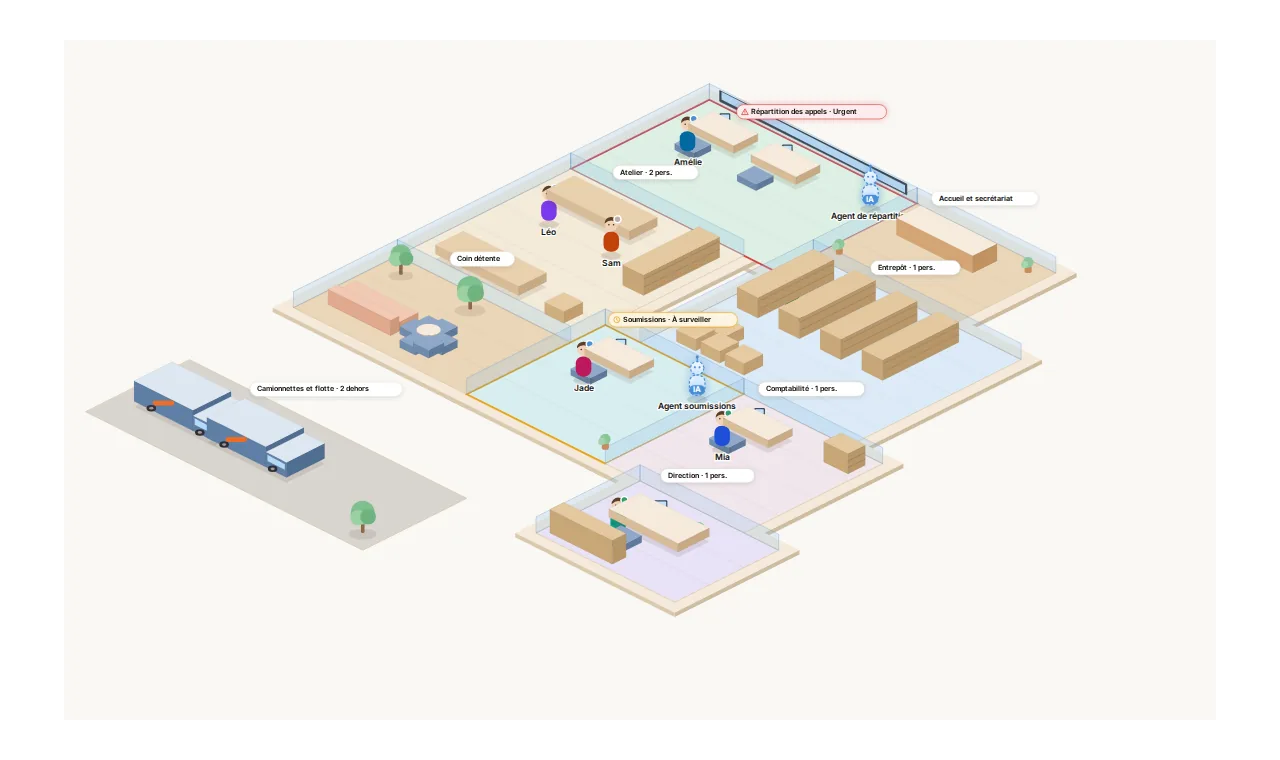
It's the core of the product. Scheduling records your bookings and customers, and internal reports turn them into indicators: bookings, revenue, workload per room of the virtual office. AI agents read that data to prepare work, and anything that touches a customer waits for a person's approval.
Frequently asked questions
Is first-party data always personal information?
No. A monthly sales total or an aggregated visit count identifies nobody. But once data can identify a person, directly or indirectly, Quebec law treats it as personal information.
What's the difference between first-party and zero-party data?
In marketing jargon, zero-party data is what people tell you on purpose, like preferences in a form. It's a subset of first-party data, and the label has no legal weight.
Does the decline of third-party cookies matter to small businesses?
Indirectly. Firefox and Safari already block that tracking by default, so targeted ads get less precise. Data you collect yourself becomes your main source of insight about customers.
Can I use booking history to send promotions?
Using personal information for commercial prospecting needs consent under section 12 of Quebec's Act. For the message itself, Canada's anti-spam law adds its own consent rules.
How long should I keep customer data?
As long as the purposes for which you collected it require, subject to retention periods set by other laws. After that, the law asks you to destroy or anonymize it.
Sources
- MDN Web Docs (Mozilla), Third-party cookies (accessed on October 15, 2026).
- LégisQuébec, Act respecting the protection of personal information in the private sector (CQLR, c. P-39.1) (accessed on October 15, 2026).
- Office of the Privacy Commissioner of Canada, Web tracking with cookies (accessed on October 15, 2026).
- Office of the Privacy Commissioner of Canada, PIPEDA requirements in brief (accessed on October 15, 2026).
Read next
- What is CRM (customer relationship management)?What CRM means, what CRM software actually holds, a follow-up calculation for a Quebec service business, and the privacy duties Quebec's Law 25 adds.
- Personal information: what counts, and what doesn't?What counts as personal information in Quebec: the legal definition, sensitive information, business contact details, inferred data and a form review.
- Cookie consent: when do you need to ask first?Cookie consent in Quebec: cookie types, section 8.1 of the private-sector privacy law, profiling off by default, and a cookie inventory for a service business.
- UTM parameters: how do you know where visitors really come from?UTM parameters explained: utm_source, utm_medium and utm_campaign, naming rules, case traps and a worked example for a Quebec service business.
- Customer lifetime value: what is a customer worth over time?Customer lifetime value explained: the simple formula, the margin-based version, a heat-pump maintenance example and what Google Analytics can predict.
- Express or implied consent: how do you know which one you have?Express vs implied consent under CASL, Quebec's private-sector Act and PIPEDA: what each one means, how to prove it, and a worked example of cleaning a list.
Your whole business, on one screen.
Each department is a room. Pilotiko prepares the work; you approve with one click.
- Call answered
- Appointment confirmed
- Email reply ready
- Invoice prepared