
Pilotiko feature : available
Express or implied consent: how do you know which one you have?
Two families of law, overlapping words. A customer's implied consent under CASL doesn't automatically cover every use of their personal information.
Express consent is given through a clear action by the person: ticking an empty box, signing, saying yes. Implied consent is inferred from a situation, such as a recent purchase, without an explicit yes. Under CASL, express consent lasts until withdrawn, while implied consent is generally time-limited. Privacy laws use the same pair of terms with different rules.
30 days free, no credit card.
In short
- CASL governs sending commercial electronic messages; privacy laws govern collecting and using personal information.
- Per the federal government, express CASL consent has no expiry unless withdrawn.
- Quebec's regulator classes a pre-ticked box as implied, not express, consent.
- Under CASL, whoever claims consent has the onus of proving it (s. 13).
Why do the same words mean different things in different laws?
Because two sets of rules overlap. CASL controls whether you may send a commercial electronic message and recognizes express or implied consent [1]. Privacy statutes control how you collect, use and disclose personal information: Quebec's regulator and the federal Privacy Commissioner both talk about express and implied consent too [3][4], but the triggers for each are different.
| Framework | What it governs | When express consent is required |
|---|---|---|
| CASL (federal) | Sending commercial electronic messages | Whenever none of the implied-consent cases in s. 10(9) applies |
| Quebec private-sector Act | Collecting, using and disclosing personal information | Notably when sensitive information is used or disclosed for another purpose |
| PIPEDA (federal) | The same activities outside Quebec or across borders | Sensitive data, uses beyond reasonable expectations, or meaningful residual risk of significant harm |
Simplified summary; read the applicable text for a specific case. Quebec's Act is written in French as “exprès” and “implicite”, while CASL's French version says “exprès” and “tacite”.
What counts as express consent?
Innovation, Science and Economic Development Canada puts it plainly: express CASL consent means the person agreed, verbally or in writing, to receive your messages, and there is no time limit unless they withdraw it [2]. When asking for it, you must set out clearly and simply the purpose and information identifying who is seeking consent (s. 10(1)) [1].
Quebec's regulator gives concrete examples in its 2023-1 guidelines. Express: signing a document, ticking a box, answering yes to a question, verbal approval. Implied: a pre-ticked box the person can untick, an inference from silence or inaction, or from some other action the person takes [3].
When is implied consent enough?
Under CASL, implied consent exists only in the cases listed in s. 10(9): an existing business or non-business relationship, an address conspicuously published without a no-solicitation statement where the message relates to the person's role, or an address handed to you without such a statement [1]. The time limits on those relationships are covered on our CASL page; the point here is that implied consent is generally time-limited [2].
On the privacy side, the federal Commissioner says organizations must generally get express consent when the information is sensitive, when the use falls outside the person's reasonable expectations, or when it creates a meaningful residual risk of significant harm [4].
How do you turn an implied list into an express one?
Who has to prove consent?
The sender. Section 13 of CASL puts the onus of proving consent on whoever alleges it [1], and the federal government advises being ready to produce that proof on request [2]. In practice, every contact in your CRM should carry the date, the source (web form, counter, phone), the exact wording shown and the type of consent.
Which consent mistakes should you avoid?
- Treating a pre-ticked box as express consent.
- Assuming implied CASL consent also covers any use of the person's information under Quebec law.
- Bundling the newsletter, partner offers and data sharing into one checkbox.
- Keeping no record of the exact wording shown when consent was given.
- Treating a business card collected at a trade show as permission for any kind of promotion.
What does Pilotiko do about consent?
In Pilotiko, consent and unsubscribe management for marketing email is built, and Pilotiko sends the emails. Any send to a customer waits for a person's approval in any case. See also our page on double opt-in, one way to document express consent.
Frequently asked questions
Does express CASL consent expire?
No. According to the federal government, it has no time limit unless the person withdraws it. That's the key difference from implied consent.
Is verbal consent valid?
Yes. CASL accepts express consent given verbally or in writing, and Quebec's regulator lists verbal approval as an express form. You still need to prove it, for example with a dated note.
Is a pre-ticked box acceptable?
Not as express consent. Quebec's regulator classes a pre-ticked box as an implied form, which won't do where the law requires express consent.
Do I need separate consent for each use?
Under Quebec's Act, consent is requested for each specific purpose. Under CASL, express consent generally covers your messages unless it was given for a specific type of message only.
What's “tacite” consent?
It's the French term CASL uses for implied consent. Quebec privacy authorities use “implicite” for the privacy-law version of the same idea.
Sources
- Justice Canada (Justice Laws), An Act to promote the efficiency and adaptability of the Canadian economy (S.C. 2010, c. 23), full text (accessed on October 15, 2026).
- Innovation, Science and Economic Development Canada, Getting consent to send email (accessed on October 15, 2026).
- Commission d'accès à l'information du Québec, Lignes directrices 2023-1 – Consentement : critères de validité (version 1.0, 31 octobre 2023) (accessed on October 15, 2026).
- Office of the Privacy Commissioner of Canada, Guidelines for obtaining meaningful consent (accessed on October 15, 2026).
Read next
- CASL: what does Canada's anti-spam law allow?CASL for small businesses: express vs implied consent, the 2-year and 6-month windows, 10 business days to unsubscribe, key exceptions and penalties.
- Quebec Law 25: what changed for small businesses?Quebec's Law 25 explained for small service businesses: the person in charge, consent, incidents, automated decisions, penalties and a costed starter checklist.
- Double opt-in: should every subscription be confirmed?Double opt-in explained: two-step sign-up, what CASL does and doesn't require, how confirmation works as proof of consent, and a worked sign-up example.
- Email newsletter: how do you run one that respects the law and your customers?Email newsletters for service businesses: what CASL requires in every issue, how often to send, how to measure results, and a realistic time budget per year.
- Cookie consent: when do you need to ask first?Cookie consent in Quebec: cookie types, section 8.1 of the private-sector privacy law, profiling off by default, and a cookie inventory for a service business.
- What is CRM (customer relationship management)?What CRM means, what CRM software actually holds, a follow-up calculation for a Quebec service business, and the privacy duties Quebec's Law 25 adds.
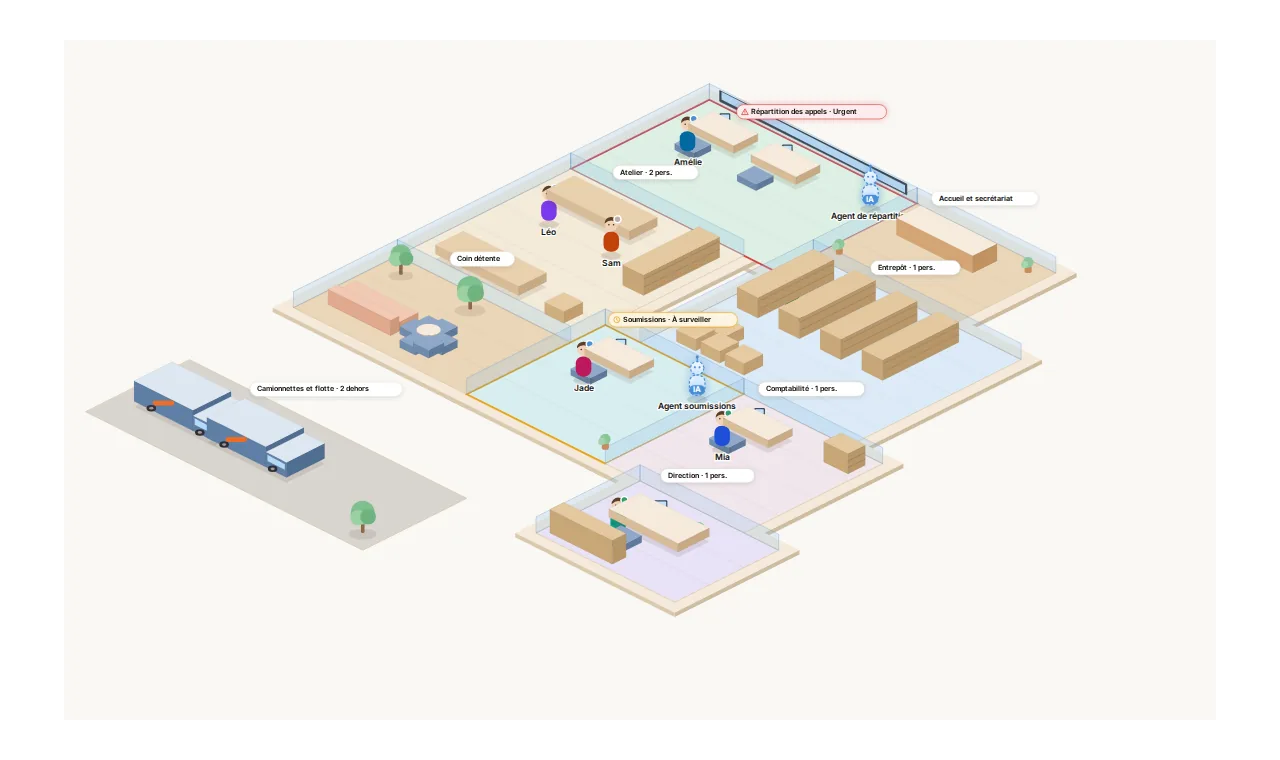
Your whole business, on one screen.
Each department is a room. Pilotiko prepares the work; you approve with one click.
- Call answered
- Appointment confirmed
- Email reply ready
- Invoice prepared