
Pilotiko feature : available
Double opt-in: should every subscription be confirmed?
One click on a form, then a second click in a confirmation email. The law doesn't demand that detour, but it solves several problems at once.
Double opt-in is a two-step subscription method: the person signs up on a form, then confirms by clicking a link sent to their inbox. The address joins the list only after that confirmation. No law we reviewed requires it, but it shows that the address really belongs to the person who consented, which helps when you must prove consent.
30 days free, no credit card.
In short
- Single opt-in: one-step sign-up. Double opt-in: sign-up plus email confirmation.
- CASL requires consent and proof of it, not a particular way of getting it.
- Under CASL section 13, the sender carries the burden of proving consent.
- The confirmation email should contain no promotion.
How does double opt-in work in practice?
- 1
Form
The person ticks an empty “Send me the newsletter” box and enters their email. The form names the business and the purpose.
- 2
Pending status
The address is stored but gets no commercial messages yet.
- 3
Confirmation email
A plain message asks them to click “Confirm my subscription”.
- 4
Confirmation
The click moves the contact to “subscribed” and logs the date, time and wording shown.
- 5
Expiry
If nobody clicks within a few days, the pending address is deleted.
Does the law require double opt-in?
Not in the texts we reviewed. CASL requires anyone seeking express consent to state clearly and simply the purpose and information identifying who is asking (s. 10(1)), and it places the onus of proving consent on whoever claims it (s. 13) [1]. The federal government adds that senders should be ready to produce that proof on request [2]. None of this dictates the mechanics; double opt-in is simply a practical way to meet the rules.
On the privacy side, Quebec's Act calls for consent that is clear, free, informed, given for specific purposes and requested for each one [4]. Quebec's regulator lists ticking a box as an express form of consent and a pre-ticked box as an implied form [3]. So a double opt-in form starts with an empty box.
| Method | Action required | Kind of consent | Proof on hand |
|---|---|---|---|
| Pre-ticked box (opt-out) | None; they have to untick | Implied, per Quebec's regulator | Weak |
| Single opt-in | Tick an empty box and submit | Express | Medium: nothing shows the address is right |
| Double opt-in | Tick, submit, then confirm by email | Express | Strong: confirmation came from the inbox itself |
Classification based on the examples in the Commission d'accès à l'information's 2023-1 guidelines.
How many sign-ups actually get confirmed?
What are the pros and cons?
Pros: solid proof of consent, a list free of typos and sign-ups made in someone else's name, and subscribers who clearly wanted to hear from you. Con: some sign-ups never get confirmed, which lowers the form's apparent conversion rate. For a small business sending a monthly newsletter, the trade-off usually favours quality.
Which double opt-in mistakes should you avoid?
- Slipping a promotion into the confirmation email; it should only confirm.
- Sending the newsletter to pending addresses “while they get around to clicking”.
- Not saving the exact form wording at the time of sign-up.
- Leaving unconfirmed addresses in the CRM forever.
- Thinking double opt-in removes the need for an unsubscribe link in every issue.
Does Pilotiko use double opt-in?
In Pilotiko, consent and unsubscribe management for marketing email is built. Real sending doesn't exist yet, so no confirmation email or newsletter leaves Pilotiko today. To pick the right consent basis, see our page on express vs implied consent.
Frequently asked questions
Is double opt-in mandatory in Canada?
No. CASL requires consent and the ability to prove it, without prescribing a method. Double opt-in is a good practice that makes the proof easier.
Is the confirmation email a commercial message?
If it only asks for confirmation, with no promotion, it simply completes the step the person just started. Add an offer and it becomes a commercial message subject to every rule.
How long should I keep an unconfirmed address?
As briefly as possible; a few days is plenty. Quebec's Act says consent is valid only for as long as needed to achieve its purposes, and information should not outlive them.
Can I move an existing list to double opt-in?
You can ask contacts who already have valid consent to reconfirm. Contacts without valid consent can't receive that request if it's commercial in nature.
What should I record at confirmation?
Date and time of sign-up and confirmation, the address, the source page and the exact wording shown. Those details demonstrate consent if a complaint comes in.
Sources
- Justice Canada (Justice Laws), An Act to promote the efficiency and adaptability of the Canadian economy (S.C. 2010, c. 23), full text (accessed on October 15, 2026).
- Innovation, Science and Economic Development Canada, Getting consent to send email (accessed on October 15, 2026).
- Commission d'accès à l'information du Québec, Lignes directrices 2023-1 – Consentement : critères de validité (version 1.0, 31 octobre 2023) (accessed on October 15, 2026).
- LégisQuébec, Act respecting the protection of personal information in the private sector (CQLR, c. P-39.1) (accessed on October 15, 2026).
Read next
- Express or implied consent: how do you know which one you have?Express vs implied consent under CASL, Quebec's private-sector Act and PIPEDA: what each one means, how to prove it, and a worked example of cleaning a list.
- CASL: what does Canada's anti-spam law allow?CASL for small businesses: express vs implied consent, the 2-year and 6-month windows, 10 business days to unsubscribe, key exceptions and penalties.
- Email newsletter: how do you run one that respects the law and your customers?Email newsletters for service businesses: what CASL requires in every issue, how often to send, how to measure results, and a realistic time budget per year.
- What is CRM (customer relationship management)?What CRM means, what CRM software actually holds, a follow-up calculation for a Quebec service business, and the privacy duties Quebec's Law 25 adds.
- Conversion rate: how do you calculate it properly?Conversion rate explained for service businesses: the formula, the stages worth tracking, a renovation example from Sherbrooke and the traps that skew it.
- Email marketing and newsletters in PilotikoNewsletters and marketing email in Pilotiko, with CASL-compliant consent and unsubscribe. Canada's anti-spam law explained plainly, step by step.
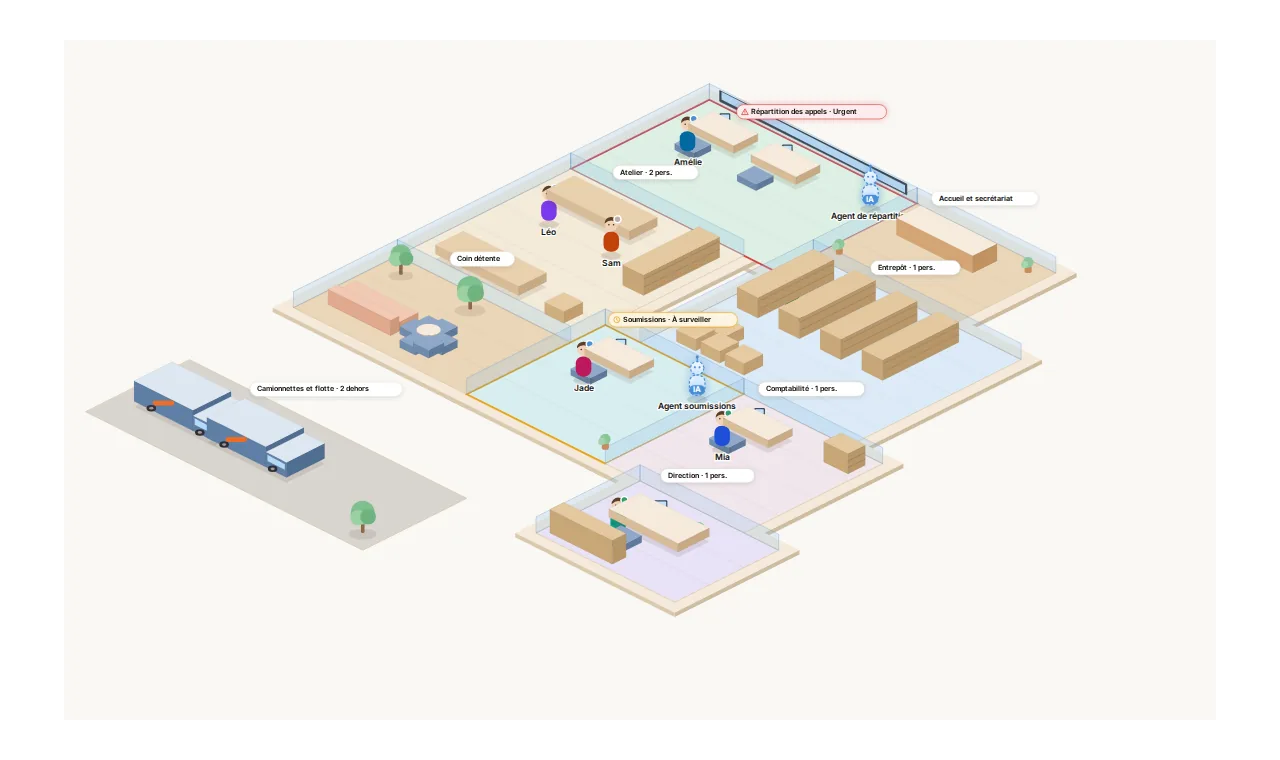
Your whole business, on one screen.
Each department is a room. Pilotiko prepares the work; you approve with one click.
- Call answered
- Appointment confirmed
- Email reply ready
- Invoice prepared