
Personal information: what counts, and what doesn't?
“Personal data” is the everyday phrase; Quebec law says personal information. Recognizing it is step one of any compliance work.
Under Quebec law, personal information is any information that relates to a natural person and directly or indirectly allows that person to be identified: name, address and phone number, but also a technician's service note or an account ID. Federal law uses a similar test: any information about an identifiable individual, factual or subjective, recorded or not.
30 days free, no credit card.
In short
- Definition: section 2 of Quebec's Act respecting the protection of personal information in the private sector.
- Sensitive information is medical, biometric or otherwise intimate, or sensitive because of its context.
- Business contact details tied to someone's job are partly carved out of the collection and confidentiality rules.
- Inferred or AI-generated data about a person is still personal information.
How does the law define personal information?
Section 2 of Quebec's private-sector Act is brief: personal information is any information which relates to a natural person and directly or indirectly allows that person to be identified [1]. Two words do the heavy lifting. “Natural” leaves out the company itself, so a corporation's business number doesn't count. “Indirectly” widens the net: a civic address plus an appointment date can be enough to pinpoint the one customer on a short street.
The federal PIPEDA, which applies among other things to personal information that crosses provincial or national borders in commercial activity, describes it as any factual or subjective information, recorded or not, about an identifiable individual, including age, income, evaluations, comments and intentions to buy [2]. Both definitions point the same way: a technician's opinion about a customer is personal information just like the customer's name.
What is sensitive personal information?
The Quebec Act calls information sensitive if, due to its nature, in particular its medical, biometric or otherwise intimate nature, or the context of its use or communication, it entails a high level of reasonable expectation of privacy [1]. Quebec's privacy regulator, the Commission d'accès à l'information, lists examples such as health, sexual orientation, biometrics, ethnic group, beliefs and financial situation [3]. The practical consequence: using or disclosing sensitive information for another purpose requires express consent (ss. 12 and 13) [1].
What isn't personal information, or isn't fully covered?
Section 1 says Divisions II and III (collection and confidentiality) don't apply to information about the performance of duties within an enterprise, such as name, title and the address, email and phone number of the workplace [1]. That information is still personal; only some rules step aside. Going the other way, the Commission considers information generated by artificial intelligence or inferred about someone to be personal information subject to the law [3].
| Information | Personal? | Note |
|---|---|---|
| A customer's name and home address | Yes | Identifies directly |
| Door or alarm code | Yes | Tied to a person and a home; protect it carefully |
| Note: “asthma, avoid certain products” | Yes, sensitive | Medical in nature |
| Property manager's name, title and work email | Yes, partly carved out | Divisions II and III don't apply to work contact details tied to someone's duties |
| “High-value customer” score computed by software | Yes | Inferred information |
| Total bookings in March | No | Aggregated; identifies nobody |
Rough guide based on sections 1, 2 and 12 of the Act and the Commission's definition page; borderline cases deserve a lawyer's view.
How much personal information is in a simple form?
Which mistakes come up most often?
- Assuming a generic address (info@…) at a one-person business is never personal; it often identifies exactly one person.
- Forgetting free-text technician notes in the CRM, which often hold sensitive details.
- Treating job-site photos as harmless when a licence plate or the customer's face is visible.
- Confusing de-identified with anonymized: the Act separates the two, and only anonymization is irreversible.
- Ignoring profiles produced by an AI agent; they are inferred information.
What does Pilotiko do with personal information?
Pilotiko stores the information your bookings and reports need: customer contact details, service addresses, history. AI agents read that data to prepare work, and anything touching a customer or a send waits for a person's approval. Protecting that information remains your business's responsibility; see our Law 25 guide for service businesses and the page on the privacy officer.
Frequently asked questions
Is personal information the same as personal data?
In substance, yes. “Personal data” is the everyday phrase popularized by European law, while Quebec's statute says “personal information”. Use the statutory term in a Quebec privacy policy.
Is an IP address personal information?
It can be, since the definition covers information that identifies someone indirectly. Combined with an account or a login time, an IP address often leads back to a specific person.
Are business contact details protected?
A person's name, title and work contact details, used in connection with their job, fall outside Divisions II and III of the Quebec Act. They are still personal information for other purposes, such as access requests.
Is public information personal information?
Yes, but Divisions II and III don't apply to information that is public by law. Something posted on social media isn't necessarily “public by law” in that legal sense.
What if a customer asks for their information?
Under section 32, the person in charge of privacy must reply in writing within 30 days of receiving the request. No reply within that time counts as a refusal.
Sources
- LégisQuébec, Act respecting the protection of personal information in the private sector (CQLR, c. P-39.1) (accessed on October 15, 2026).
- Office of the Privacy Commissioner of Canada, PIPEDA requirements in brief (accessed on October 15, 2026).
- Commission d'accès à l'information du Québec, Qu'est-ce qu'un renseignement personnel? (accessed on October 15, 2026).
Read next
- Quebec Law 25: what changed for small businesses?Quebec's Law 25 explained for small service businesses: the person in charge, consent, incidents, automated decisions, penalties and a costed starter checklist.
- What is CRM (customer relationship management)?What CRM means, what CRM software actually holds, a follow-up calculation for a Quebec service business, and the privacy duties Quebec's Law 25 adds.
- First-party data: which data is really yours?First-party data explained: how it differs from third-party data, Quebec rules on collecting and using it, and a worked example from a service business.
- Privacy impact assessment: when must a Quebec business do one?Privacy impact assessments for Quebec businesses: when the law requires one (ss. 3.3 and 17), the regulator's six steps, and a time estimate for new software.
- Privacy officer: who is it in a Quebec business, and what do they do?Quebec's person in charge of personal information protection: who holds the role by default, how to delegate it, day-to-day duties and the time to plan.
- What is an AI agent?An AI agent pursues a goal by chaining steps and tools on its own. Definition, the agent loop, a worked example for a Quebec SME and the guardrails it needs.
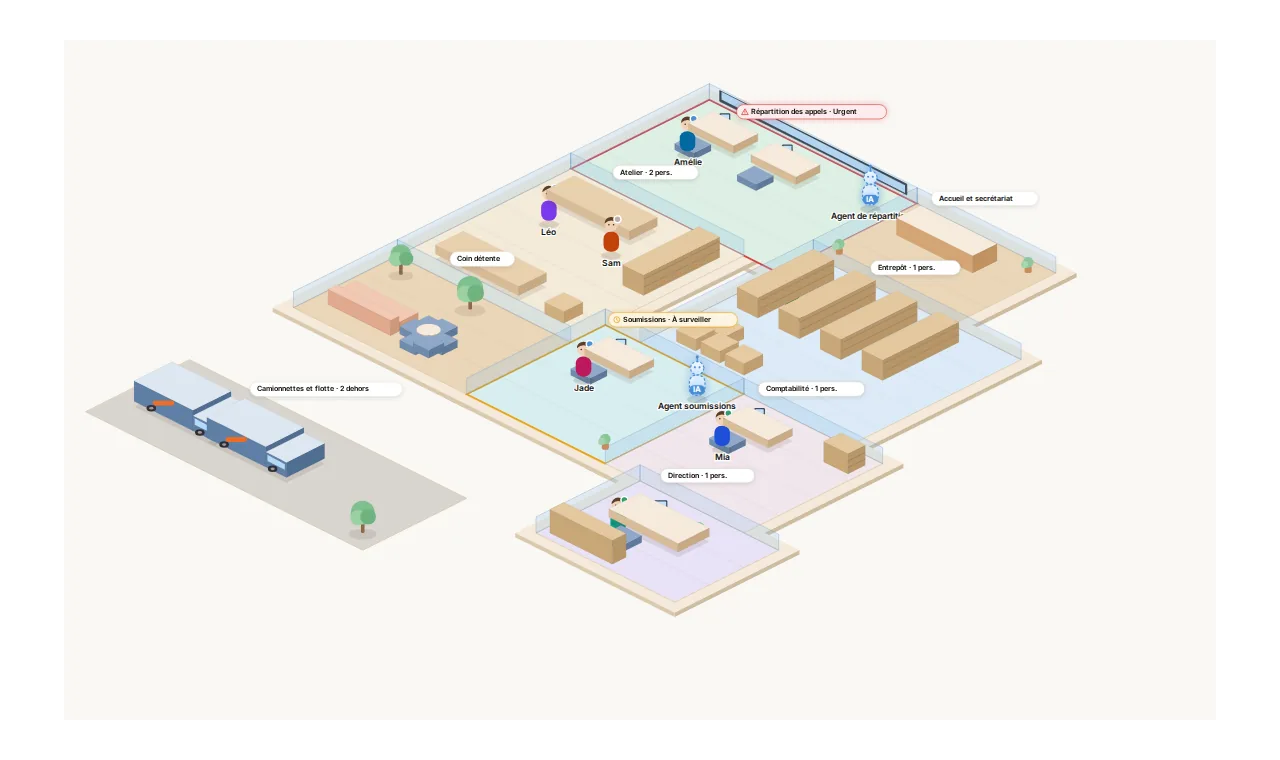
Your whole business, on one screen.
Each department is a room. Pilotiko prepares the work; you approve with one click.
- Call answered
- Appointment confirmed
- Email reply ready
- Invoice prepared