
Privacy impact assessment: when must a Quebec business do one?
Switching booking software or handing data to a host outside Quebec triggers an obligation many small businesses miss.
A privacy impact assessment (PIA) is an analysis a business carries out before a project that involves personal information, to spot privacy risks and plan measures to reduce them. In Quebec it is mandatory before acquiring, developing or overhauling an information system, and before communicating personal information outside Quebec, among other situations.
30 days free, no credit card.
In short
- Section 3.3: a PIA for any project to acquire, develop or overhaul an information system involving personal information.
- Section 17: a PIA before communicating personal information outside Quebec.
- The depth of the assessment is proportionate to sensitivity, purpose, quantity, distribution and medium.
- The regulator's guide suggests six steps, but the law sets no method or report format.
What does Quebec law say about PIAs?
Section 3.3 of Quebec's private-sector privacy Act requires every business to conduct a privacy impact assessment for any project to acquire, develop or overhaul an information system or electronic service delivery system involving the collection, use, communication, keeping or destruction of personal information. The business must consult its privacy officer from the outset and make sure the system can hand people their computerized information in a structured, commonly used technological format [1].
Section 17 adds a second trigger. Before communicating personal information outside Quebec, or entrusting someone outside Quebec with collecting, using, communicating or keeping it, the business must do a PIA that weighs the sensitivity of the information, the purpose, the protection measures (including contractual ones) and the legal framework of the destination. The transfer can go ahead only if the information will be adequately protected, and it requires a written agreement [1].
| Situation | Section (private-sector Act) | In force since |
|---|---|---|
| Acquiring, developing or overhauling an information or electronic service delivery system | 3.3 | September 22, 2023 |
| Communicating information outside Quebec, or outsourcing its handling there | 17 | September 22, 2023 |
| Disclosing without consent, under an agreement, for study, research or statistics | 21 | September 22, 2022 |
From the table of mandatory situations in the Commission d'accès à l'information's PIA guide (version 3.1, April 2024, in French).
How does a PIA unfold, step by step?
The law doesn't say how to run the assessment or what the report should contain, and Quebec's regulator states that its guide doesn't have to be followed to the letter [2]. Its six-step approach still works well for a small business. Federal guidance describes the same tool as an early-warning system that helps find the least privacy-intrusive way to reach a legitimate goal [3].
- 1
Decide whether an assessment is needed
Does the project touch personal information? Does an existing assessment just need updating?
- 2
Define the project and the scope
Describe the project, its goals and what the assessment covers.
- 3
Prepare
Inventory the information, map how it flows and decide how deep to go.
- 4
Assess and choose measures
Check compliance, weigh the risks and plan how to remove or reduce them.
- 5
Write a report
Document the process so you can show you met your obligations.
- 6
Keep it current
Revisit the assessment whenever the project changes.
How long does a PIA take in a small business?
Who does the PIA, and what is the privacy officer's role?
The duty falls on the business. The privacy officer must be consulted from the start, and section 3.4 lets that person suggest measures at any stage: naming someone to implement them, writing them into project documents, describing each participant's responsibilities or running training [1].
Which PIA mistakes should you avoid?
- Signing with a SaaS vendor before the assessment, when negotiable safeguards are still on the table.
- Skipping section 17 because the vendor is “Canadian”: hosting in Ontario is outside Quebec.
- Copying a large company's report instead of scaling the analysis to your project.
- Not updating the assessment after an overhaul or a vendor change.
- Overlooking data export formats, which section 3.3 explicitly asks you to check.
Does Pilotiko do the PIA for you?
No. Adopting Pilotiko, like any management software, is a project to acquire an information system, so the PIA belongs to your business. Ask every vendor, Pilotiko included, the same questions: where is the data hosted, who can access it, how do you export it. Our guide to choosing management software and our Law 25 guide help you prepare them.
Frequently asked questions
Is a PIA mandatory for a small business?
Yes, in the situations the law lists, with no size threshold. Its depth is proportionate to the sensitivity, quantity and medium of the information, so a very small business can produce a short assessment.
Do I have to file my PIA with the regulator?
Sections 3.3 and 17 require you to carry out the assessment; they don't provide for filing it with the regulator. The guide treats the report as the way to document your process and show, if asked, that you met your obligations.
Does switching booking software require a PIA?
If the new software handles personal information, it's an information-system acquisition under section 3.3. If it stores data outside Quebec, section 17 applies too.
Must a PIA follow a set template?
No. The law sets no method or format. The Commission's guide proposes six steps, but it is explanatory and doesn't replace the statute.
What's the French term for a PIA in Quebec?
Évaluation des facteurs relatifs à la vie privée, often shortened to EFVP. It's the term used in the statute and by Quebec's privacy regulator.
Sources
- LégisQuébec, Act respecting the protection of personal information in the private sector (CQLR, c. P-39.1) (accessed on October 15, 2026).
- Commission d'accès à l'information du Québec, Réaliser une évaluation des facteurs relatifs à la vie privée : guide d'accompagnement (version 3.1, avril 2024) (accessed on October 15, 2026).
- Office of the Privacy Commissioner of Canada, OPC's Guide to the Privacy Impact Assessment Process (accessed on October 15, 2026).
Read next
- What is an information system (IS)?What an information system is for a small business: hardware, software and people, how it differs from IT, a quick inventory example and Quebec privacy duties.
- What is SaaS (software as a service)?What SaaS means, how it differs from installed software, a three-year subscription calculation for a Quebec service SME and the contract traps to avoid.
- Personal information: what counts, and what doesn't?What counts as personal information in Quebec: the legal definition, sensitive information, business contact details, inferred data and a form review.
- Privacy officer: who is it in a Quebec business, and what do they do?Quebec's person in charge of personal information protection: who holds the role by default, how to delegate it, day-to-day duties and the time to plan.
- Quebec Law 25: what changed for small businesses?Quebec's Law 25 explained for small service businesses: the person in charge, consent, incidents, automated decisions, penalties and a costed starter checklist.
- How to choose business management software for a service companyWeighted scoring, vendor questions, Law 25, data hosting and portability: a practical method for choosing management software for a Quebec service business.
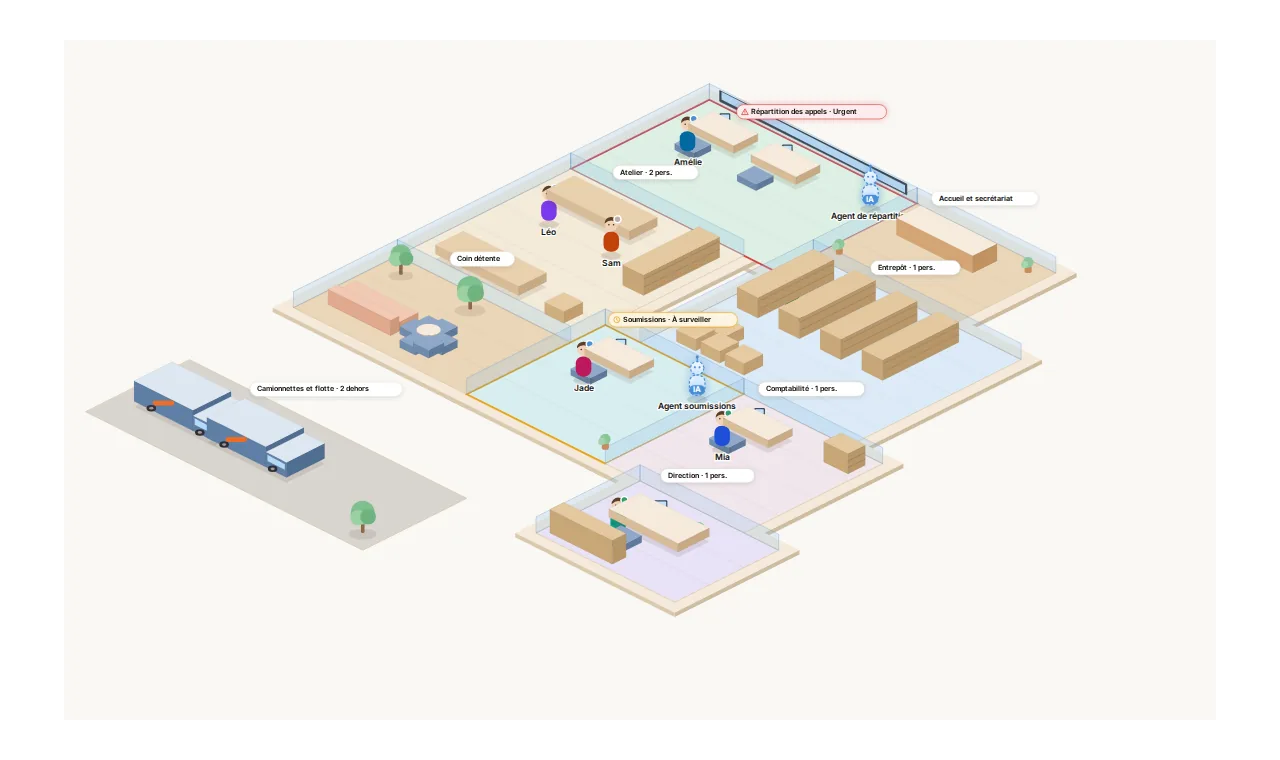
Your whole business, on one screen.
Each department is a room. Pilotiko prepares the work; you approve with one click.
- Call answered
- Appointment confirmed
- Email reply ready
- Invoice prepared