

Pilotiko feature : available
Retention rate: how many of your customers stick around?
The number that tells you whether last year's customers are still this year's customers.
Customer retention rate is the percentage of customers you had at the start of a period who are still doing business with you at the end of it. You calculate it by taking the customer count at the end, removing the new customers gained during the period, and dividing by the count you started with.
30 days free, no credit card.
In short
- Common formula: (customers at end − new customers) ÷ customers at start × 100.
- Always tied to a period: a month, a season or a year.
- It mirrors churn: if 88% stayed, 12% left.
- In French, Quebec's language office prefers taux de fidélisation [3].
How do you calculate customer retention rate?
The Business Development Bank of Canada (BDC) uses three counts: S, customers at the start of the period; E, customers at the end; N, new customers acquired during the period. Retention equals (E − N) ÷ S × 100. In BDC's worked example, a business starts with 500 customers, ends with 550 and gained 100 new ones along the way, which gives 90% [1].
Subtracting new customers is the step people skip. Leave it out and a strong sales quarter hides the regulars who quietly stopped calling: the headcount rises while the original base shrinks.
| Rate | BDC's reading |
|---|---|
| Above 90% | Exceptional: strong loyalty and satisfaction |
| 80–90% | Great: most customers stay |
| 70–80% | Good: acceptable, with room to improve |
| Below 70% | Low: possible issues with satisfaction, fit or competition |
General benchmarks from BDC [1], which notes that rates vary by sector (it cites 75–90% as good for subscription services). They are not standards for your trade.
What does the calculation look like for a service business?
What counts as an active customer when there is no contract?
With subscriptions the answer is built in: the customer is paying or has cancelled. Stripe counts a subscriber as active when they have positive monthly recurring revenue and a subscription in active or past_due status [2]. A trade business without contracts has to pick its own rule and keep it.
For a groomer, one visit in the past 12 months is reasonable. For a tire shop, two seasonal changeovers a year. For a chimney sweep, one annual visit. Write the rule beside the formula, or two people will get two different rates from the same records.
What is cohort retention?
A cohort is a group of customers who started at the same time, say everyone who first booked in January. You then track how many of them remain each month. Stripe shows how losses compound: at 10% monthly churn, a cohort keeps 90% after one month, 81% after two, 73% after three and 59% after five [2].
Stripe also separates subscriber retention from revenue retention. Revenue retention counts customers who spend more and can climb above 100% [2]. For a small business, comparing two cohorts (referrals versus a discount promotion, for instance) often tells you more than a single company-wide average.
Which mistakes distort retention rate?
- Forgetting to subtract new customers, which can push the rate past 100% and make it meaningless.
- Redefining an active customer from one quarter to the next.
- Comparing peak season with off-season in a seasonal trade.
- Lumping commercial accounts in with households, who rebook on very different cycles.
- Reading the rate without customer lifetime value: keeping 95% of small accounts doesn't make up for losing two large contracts.
What does Pilotiko do to track retention?
Pilotiko does not calculate a retention rate automatically. Its internal reports, available today, count bookings per period, the value of services booked and completed, and the number of new customers created in the period; see reports and steering. That gives you N in the formula.
For S and E, decide on your active-customer rule, then count from each customer's booking history. The result can become a key performance indicator you review every quarter, read alongside its mirror image, the churn rate, for the same period.
Frequently asked questions
What is the formula for customer retention rate?
Retention rate = (customers at end of period − new customers during period) ÷ customers at start × 100. With 500 at the start, 550 at the end and 100 new, you get 90%. Fix the period before you count.
How is retention rate different from churn rate?
They are two sides of the same calculation over the same period. If 85% of starting customers stayed, 15% left. Retention is the number to watch when you work on loyalty; churn is the one to dig into when you want to understand departures.
What is a good customer retention rate?
BDC describes 80–90% as great and anything above 90% as exceptional, while stressing that benchmarks differ by sector. Your best comparison is your own rate from last year, calculated with the same rule.
What is the French term for retention rate in Quebec?
The Office québécois de la langue française recommends taux de fidélisation and lists taux de rétention de la clientèle as a calque to avoid. Use the recommended term in French-language reports and marketing.
How often should a small business measure retention?
Match the rhythm of your customers' buying cycle. A hair salon might check quarterly, a snow-removal company once per season. Measuring a long cycle too often mostly produces noise.
Sources
- BDC, What is customer retention rate? (accessed on October 15, 2026).
- Stripe, Billing analytics (metric definitions: MRR, churn, retention) (accessed on October 15, 2026).
- Office québécois de la langue française, taux de fidélisation (Grand dictionnaire terminologique) (accessed on October 15, 2026).
Read next
- Churn rate: how many customers are you losing?Churn rate explained: customer churn versus revenue churn, two competing formulas, a snow-removal contract example from Quebec and the mistakes that skew it.
- Customer lifetime value: what is a customer worth over time?Customer lifetime value explained: the simple formula, the margin-based version, a heat-pump maintenance example and what Google Analytics can predict.
- What is a KPI (key performance indicator)?What a KPI is, how to derive one from a business goal, formulas for a service company, a worked month of numbers and the traps to avoid when picking them.
- Reports and steering: your numbers without a spreadsheetPilotiko reports: services, value, cancellations, new customers and staff workload over six periods. What they measure today, and what they do not measure yet.
- What is a management dashboard?What a management dashboard is, leading versus lagging indicators, how it differs from a report, a snow-removal example and mistakes that make it useless.
- SME: what is a small and medium-sized enterprise?What counts as an SME in Canada and Quebec: federal and Quebec definitions compared, the December 2024 Quebec figures and the classification mistakes to avoid.
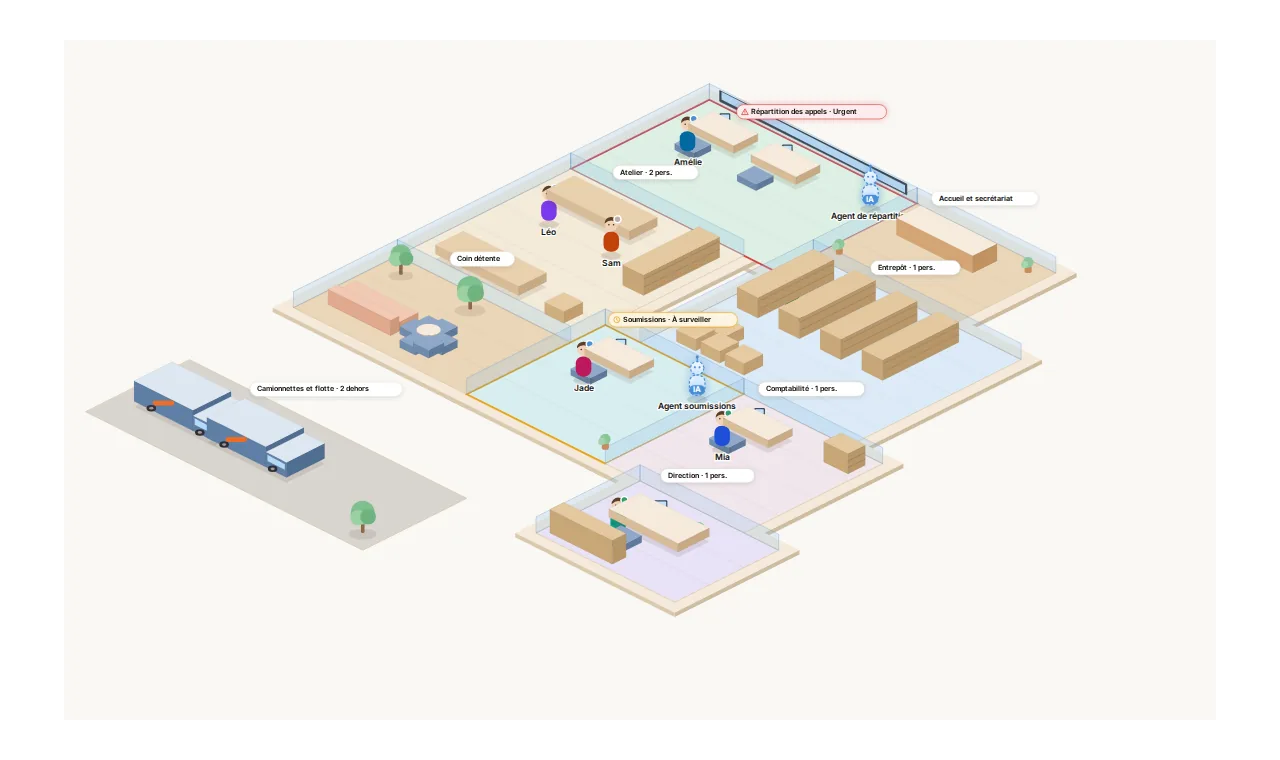
Your whole business, on one screen.
Each department is a room. Pilotiko prepares the work; you approve with one click.
- Call answered
- Appointment confirmed
- Email reply ready
- Invoice prepared