

Pilotiko feature : available
Pillar page: what is a page that covers a whole topic for?
The front door to a topic, the page everything else points back to.
A pillar page is an in-depth page that presents a broad topic as a whole, such as “Residential heat pumps”, and uses internal links to send readers to more detailed pages on each subtopic, which link back to it. The term comes from content marketing; Google gives it no official definition, but it rests on principles Google describes.
30 days free, no credit card.
In short
- It's a writing and site-architecture concept, not a tag or a technical setting.
- It answers the broad question; supporting pages answer the narrow ones.
- Google: every page you care about should get a link from at least one other page on your site.
- A thin pillar page that's just a list of links helps no one.
Where does the idea of a pillar page come from?
The phrase comes from content marketing, not from search engine documentation. Neither Google nor Bing defines a “pillar page”; it's a way of organising a site. It does rest on principles Google spells out, though: links help it discover pages and judge their relevance, and the vast majority of new pages Google finds every day are found through links [2].
A pillar page sits at the centre of a topic cluster. The site you're reading has a few, such as visibility on Google and in AI answers or automation for service businesses: each one sums up a broad subject and points to narrower guides and definitions.
How does a pillar page differ from an ordinary page?
| Criterion | Pillar page | Supporting page | Service page |
|---|---|---|---|
| Question covered | Broad: “How do I choose a heat pump?” | Narrow: “What yearly maintenance?” | Commercial: “Installation in Gatineau” |
| Typical length | Long, with a table of contents | Medium | Short to medium |
| Outgoing internal links | To every supporting page | To the pillar and 1 or 2 neighbours | To booking or a quote request |
| Dominant intent | Learn, compare | Learn something specific | Act |
| Updates | Whenever a subtopic changes | As needed | When the offer changes |
Pilotiko's grid; no standard sets these lengths.
How should a pillar page be structured?
Open with a short answer to the topic, then a table of contents. Each section sums up one subtopic in a few paragraphs and ends with a link to the page that covers it in full. Google recommends taking care with internal anchor text, since descriptive link text helps both people and Google make sense of your content [1]. “Heat pump annual maintenance” beats “click here”.
Google also says there's no magic number of links per page, but if you think it's too many, it probably is [1]. A pillar page isn't a directory: it has to deliver a real overview, with comparisons, ballpark figures and hands-on experience, the kind of thing associated with E-E-A-T.
What does a pillar page look like for a service business?
Which pillar-page mistakes should you avoid?
- Writing a pillar that repeats the supporting pages word for word, so it competes with them, a case of cannibalization. Microsoft advises consolidating pages that target the same intent so one page carries the links and engagement [3].
- Turning it into a bare list of links with no content of its own.
- Picking a topic too narrow to justify more than one page.
- Forgetting the link back from each supporting page to the pillar.
- Letting it go stale; when a subtopic changes (prices, regulations), the summary has to follow.
What does Pilotiko do for your pillar pages?
Pilotiko's content drafting and editorial calendar are available: an agent can outline a pillar page and its supporting pages, then draft them for you to approve before anything is published. On the site Pilotiko builds and hosts, new pages are added to the sitemap automatically. To choose your links, see internal linking and search intent.
Frequently asked questions
Is a pillar page a Google ranking factor?
No. Google doesn't talk about pillar pages. It's an organising method built on principles Google does describe: crawlable links, clear anchor text and useful pages.
How long should a pillar page be?
There's no official length. It should cover each subtopic well enough to make the whole picture clear, without copying the detailed pages.
How many supporting pages do I need?
As many as there are distinct questions your customers actually ask about the topic. For a small business, 5 to 10 pages per major topic is a common ballpark, to adjust to your situation.
Can my home page be the pillar page?
Rarely. The home page introduces the whole business, while a pillar page goes deep on one subject. It can still link to your pillar pages.
Should every service get a pillar page?
Only services rich enough to justify several detailed pages. A simple service usually does fine with one solid service page and an FAQ.
Sources
- Google Search Central, Link best practices for Google (accessed on October 15, 2026).
- Google Search Central, SEO Starter Guide (accessed on October 15, 2026).
- Microsoft Bing Blog, Does Duplicate Content Hurt SEO and AI Search Visibility? (accessed on October 15, 2026).
Read next
- Topic cluster: how do you group your content by subject?Topic clusters explained: grouping pages and queries by broad subject around a pillar page. A 4-step method, a worked example and the mistakes to avoid.
- Internal linking: why link your own pages to each other?Internal linking connects the pages of one website. What Google says about crawlable links, anchor text and orphan pages, plus a worked small business audit.
- Keyword cannibalization: are your pages competing with each other?Keyword cannibalization explained: when your own pages compete for one query, how to spot it in Search Console and how to merge pages without losing traffic.
- Search intent: what does the searcher actually want?Search intent explained: the Know, Do, Website and Visit-in-person intents Google describes, a Quebec service-business example and the mistakes to avoid.
- Getting found on Google and cited by AI: SEO, AEO and GEO for Quebec small businessesA complete guide for Quebec SMBs: technical and local SEO, direct answers, structured data, AI crawlers, llms.txt and measurement. No ranking promises.
- How to automate a service business in Quebec: the complete guideBookings, dispatch, follow-up, reminders, Law 25 and CASL: what a Quebec service business can automate, what should stay human, and where to start.
Your whole business, on one screen.
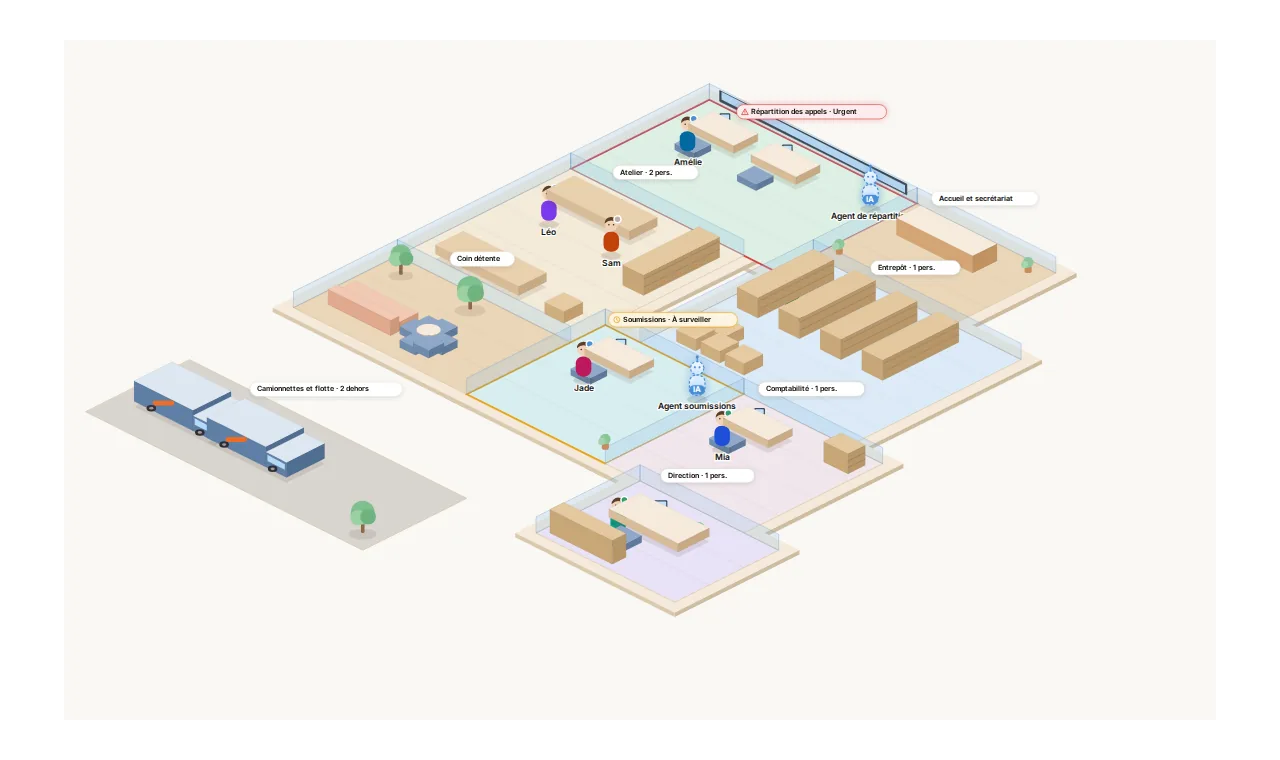
Each department is a room. Pilotiko prepares the work; you approve with one click.
- Call answered
- Appointment confirmed
- Email reply ready
- Invoice prepared