
Pilotiko feature : available
Meta description: what should appear under your page title on Google?
A short summary nobody sees on your site, yet one that searchers often read in the results.
A meta description is an HTML <meta name="description"> tag that offers a short summary of a page. Google may show it as the snippet under the title link when it describes the page better than text pulled from the page itself. It is invisible on the site; its job is to persuade a searcher to click through.
30 days free, no credit card.
In short
- It goes in the <head>: <meta name="description" content="…">.
- Google builds most snippets from page content; the meta description is a suggestion.
- There is no official length limit, but snippets are cut to fit the device width.
- Write a different description for each page; duplicates add little.
- The nosnippet and max-snippet rules restrict or block the snippet.
Where does the grey text under a Google result come from?
Google calls it a snippet and generates it automatically, mostly from the page content, to highlight whatever best matches the query; the same page can therefore show different snippets for different searches [1]. Google sometimes uses the meta description instead, when it gives a more accurate picture of the page than on-page text would [1].
MDN describes the tag as a short, accurate summary of the page's content, commonly called the meta description [2]. In other words, you propose and Google decides. A strong description simply improves the odds that your own summary appears, instead of a sentence clipped from the middle of a paragraph.
How long should a meta description be?
Google says there is no limit on meta description length, but snippets are truncated as needed, typically to fit the device width [1]. Google publishes no magic number. Audit tools, Pilotiko's included, use benchmarks such as 70 to 160 characters; those are practical conventions, not a search-engine rule.
The real constraint is that the description should still make sense if its end is cut off. Put whatever wins the click in the first half.
| Element | Who decides | Effect |
|---|---|---|
| <meta name="description"> | You | Suggested summary Google may reuse |
| Displayed snippet | Picked per query, often drawn from the page | |
| nosnippet | You | No text snippet at all for the page |
| max-snippet:[number] | You | Maximum snippet length in characters |
| data-nosnippet | You | Keeps a specific part of the page out of snippets |
Sources: Google Search Central [1] and the robots meta tag specifications [3].
What makes a good meta description?
Google recommends a unique description for each page that accurately reflects its content; if time is short, start with the home page and your most visited pages [1]. It adds that the description doesn't have to be a sentence: it can bundle useful facts such as price, author or publication date [1]. It also warns that long strings of keywords are unlikely to be shown [1].
For a service business, the details that earn clicks are concrete: the area served, turnaround, one specific feature of the offer, and how to take the next step. The title tag names the service; the description answers “why you, and how?”.
How would you rewrite the descriptions on a service site?
Which meta description mistakes should you avoid?
- Copying one description onto every page; Google says identical descriptions are of little help when several pages appear together [1].
- Listing comma-separated keywords instead of describing the page [1].
- Promising something the page doesn't deliver, so the visitor bounces straight back.
- Expecting it to control indexing; to keep a page out of results you need the noindex rule.
- Adding nosnippet by reflex: the page loses its snippet everywhere, including Google's AI Overviews [3].
Does the meta description shape AI answers?
Indirectly at most. Google's robots documentation says nosnippet and max-snippet also apply to AI Overviews and AI Mode, and stop the content from being used as direct input there [3]. For a generated answer to echo your wording, the page body matters far more, which is why featured snippets and a well-written FAQ deserve attention.
What does Pilotiko do with meta descriptions?
On the site it builds and hosts, Pilotiko adds a meta description to every page and checks it before publishing, flagging any that are missing or unusually short or long. On your existing site, the audit lists pages without a description and those outside a 70-to-160-character range, and suggests writing the missing ones first. Any drafted text waits for your approval.
Frequently asked questions
Does the meta description help rankings?
Google doesn't present it as a ranking factor; it describes it as one possible source of the snippet. Its main job is to make people want to click when it is shown.
Why isn't Google showing my meta description?
Google mostly builds snippets from page content and picks the passage closest to the query. Your description gets used more often when it truly summarizes the page rather than listing keywords.
Does every page need a meta description?
Ideally yes, and a different one for each. If time is tight, Google suggests starting with the home page and your busiest pages.
Can I set the meta description without editing HTML?
Yes. Most content management systems have a field for it in the page settings. Google suggests searching your platform's help for something like “add meta description” plus the platform name.
How is it different from the Open Graph description?
The meta description is aimed at search engines. og:description feeds the preview when a link is shared on social media or in messaging apps. They can carry the same text, but they are separate tags.
Sources
- Google Search Central, How to write meta descriptions (accessed on October 15, 2026).
- MDN Web Docs, <meta name> HTML attribute (accessed on October 15, 2026).
- Google Search Central, Robots meta tag, data-nosnippet and X-Robots-Tag specifications (accessed on October 15, 2026).
Read next
- Title tag: how should you name a page for Google and for customers?The title tag names each page for Google, the browser tab and screen readers. Recommended length, structure, a worked example and the mistakes to avoid.
- Featured snippet: what is it?Google's featured snippet explained: what it is, why you can't mark it up, how to opt out, and a rewritten page example from a Quebec service business.
- SEO: what is search engine optimization?What SEO really covers, how Google finds and ranks pages, a worked example for a Quebec service business and the mistakes that quietly cost visibility.
- Click-through rate (CTR): how do you calculate and read it?Click-through rate in search: the clicks ÷ impressions formula, where to read it in Search Console and why a low CTR isn't always bad news for a business.
- Noindex: how do you keep a page out of search results?The noindex rule keeps a page out of Google's results through a robots meta tag or an X-Robots-Tag header. Uses, the robots.txt trap, a calculation and errors.
- Writing an FAQ that still pays off in Google and in AI answersFAQ rich results left Google in May 2026. Here's how to write an FAQ that still helps customers, earns snippets and feeds AI answers. A guide for SMBs.
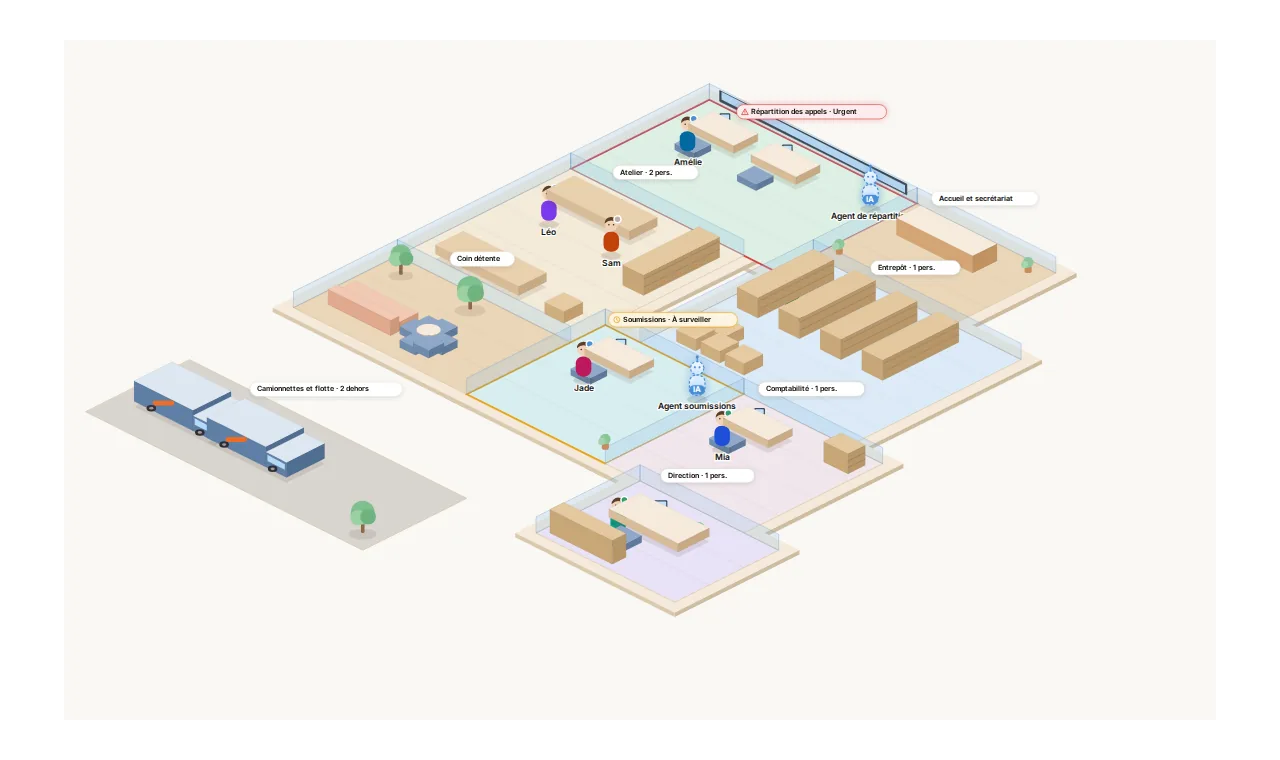
Your whole business, on one screen.
Each department is a room. Pilotiko prepares the work; you approve with one click.
- Call answered
- Appointment confirmed
- Email reply ready
- Invoice prepared