

Pilotiko feature : available
Click-through rate (CTR): how do you calculate and read it?
The first number that tells you whether your listing makes people want to pick it.
Click-through rate, or CTR, is the number of clicks divided by the number of impressions, shown as a percentage. In organic search it measures the share of people who saw your listing on Google and then clicked it. Five clicks from 100 impressions, for instance, is a 5% CTR. It says nothing about what visitors do once they land.
30 days free, no credit card.
In short
- Formula: clicks ÷ impressions × 100.
- Search Console shows it by query, page, country and device.
- Google Ads notes that a “good” CTR depends on your industry and network.
- A low CTR in a high position can mean the answer was already visible on the results page.
How is click-through rate calculated?
Search Console Help defines it plainly: CTR is the click count divided by the impression count [1]. Google Ads Help gives the same formula with an example: 5 clicks and 100 impressions make a 5% CTR [2].
In the Performance report, an impression is counted when your link appears in search results, and a click when someone picks it to reach your site [4]. CTR links two moments: being seen, then being chosen. What happens after the visit is a job for conversion rate.
Where do you find CTR in Search Console?
By default the Performance report shows clicks and impressions for the last three months; you switch on average CTR and average position by clicking their headers above the chart [1]. The Queries, Pages, Countries and Devices tabs then let you compare CTR across whichever dimension you pick [1].
Watch the totals. In the chart, data is aggregated by property, while the Pages tab aggregates by page. Two results from the same site for one query count as a single impression in the chart [1], so chart totals can differ slightly from the sum of the table.
Why can a well-ranked result have a low CTR?
Google lists several reasons in its bubble-chart guide [3]. Competitors may show rich results thanks to structured data, which draw the eye. Your page may rank for a query the people typing it don't really care about. Or searchers may already have found what they needed (opening hours, address, phone number) right on the results page.
That last case is common for service businesses: if someone sees your number in your Google Business Profile and calls, the click to the website never happens. Google notes that if your goal is to bring customers to your location, that's expected behaviour [3].
| Position | CTR | Google's reading | Possible action |
|---|---|---|---|
| High | High | Little extra investment needed | Keep the page current |
| Low | High | The query matters to people | Strengthen the page to climb |
| Low | Low | Related or unrelated query | Prioritise only if it matters to you |
| High | Low | Competing rich results, answer already visible, low-value query | Rework title and snippet, check intent |
Quadrants from Google Search Central's bubble-chart guide [3].
Which CTR mistakes should you avoid?
- Benchmarking against an “industry average CTR” from a blog post; Google Ads says a good CTR depends on what you sell and the networks you use [2].
- Averaging CTRs from different pages instead of recalculating total clicks ÷ total impressions.
- Drawing conclusions from 30 impressions; wait for enough volume.
- Writing a clickbait title the page doesn't deliver on, so the click is followed by a quick back-button.
- Mixing up Google Ads CTR with organic CTR; they're read in different contexts.
What does Pilotiko do with click-through rate?
Pilotiko's internal reports track bookings, revenue and workload; they don't replace Search Console, which is where CTR lives. For the site it builds and hosts, Pilotiko generates the structured data that makes pages eligible for rich results, with no guarantee they'll appear. To pick your key performance indicators, start with Google Search Console and impressions.
Frequently asked questions
What's a good click-through rate for SEO?
There's no universal figure. CTR depends on position, the query, what else appears on the results page and your industry. Compare a page with its own history and with your site's median instead.
Does CTR affect rankings?
Google says it uses aggregated and anonymized interaction data to assess relevance [5], without spelling out CTR's exact role. Treat CTR as a measure of how appealing your listing is rather than a lever to game.
Why is my CTR falling while my clicks are rising?
Your impressions are probably growing faster than your clicks, often because you now appear for new queries in lower positions. Check the Queries tab to see which ones were added.
How do I improve a page's CTR?
Write a precise page title and a description that answers the intent, add relevant structured data and make sure the content matches the query. Measure before and after over equal-length periods.
Is Search Console CTR the same as Google Ads CTR?
The formula is the same: clicks divided by impressions. The context differs: one measures your organic listings, the other your paid ads, each with its own display rules.
Sources
- Search Console Help (Google), Performance report (Search results): overview and basic setup (accessed on October 15, 2026).
- Google Ads Help, Clickthrough rate (CTR): Definition (accessed on October 15, 2026).
- Google Search Central, Improve SEO with a bubble chart (accessed on October 15, 2026).
- Search Console Help (Google), What are impressions, position, and clicks? (accessed on October 15, 2026).
- Google (How Search Works), How Google Search organizes and ranks results (accessed on October 15, 2026).
Read next
- Search Console impressions: what exactly gets counted?What a Search Console impression really counts: display rules, carousels, property versus page aggregation, and a seasonal example with figures.
- Google Search Console: what is Google's free site tool for?Google Search Console explained: what the free tool does, how to verify your site, which reports to open each month and the mistakes small businesses make.
- SERP: what is a search engine results page?What a SERP is, the visual elements Google lists on a results page, why two people rarely see the same one, and how a Quebec service business reads it.
- Conversion rate: how do you calculate it properly?Conversion rate explained for service businesses: the formula, the stages worth tracking, a renovation example from Sherbrooke and the traps that skew it.
- Structured data: what are schema.org and JSON-LD?Structured data, schema.org and JSON-LD explained: formats Google accepts, a LocalBusiness markup example for a Quebec small business and the usual mistakes.
- What is a Google Business Profile?What a Google Business Profile is, how Google ranks local listings, the rules for name, address and phone, and a worked example for a Quebec service business.
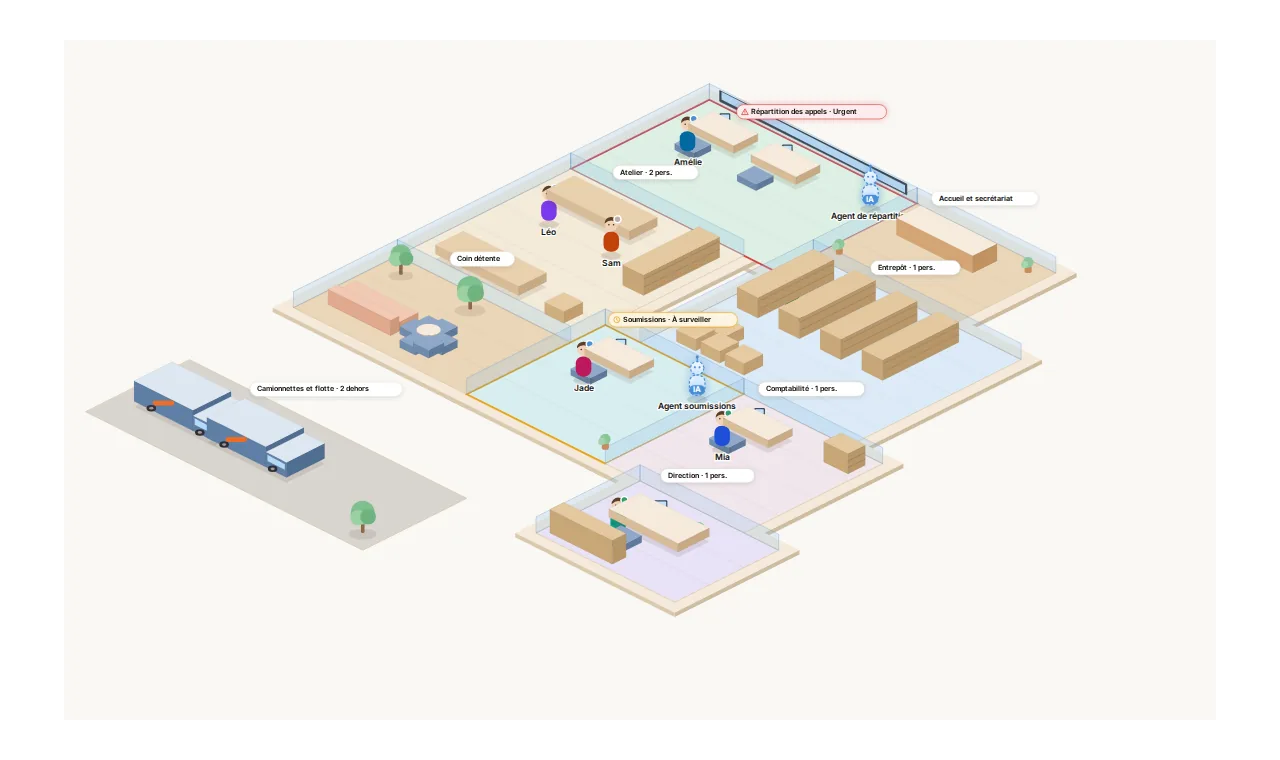
Your whole business, on one screen.
Each department is a room. Pilotiko prepares the work; you approve with one click.
- Call answered
- Appointment confirmed
- Email reply ready
- Invoice prepared