
Pilotiko feature : available
SERP: what is a search engine results page?
Everything a searcher sees between typing a query and landing on your site, broken into parts.
A SERP (search engine results page) is the page Google, Bing or another engine shows after someone runs a query. It blends text results, rich results, images, videos, ads and exploration features. Its layout shifts with the device, the country, the query language and the query itself, so no two SERPs are guaranteed to match.
30 days free, no credit card.
In short
- SERP stands for search engine results page.
- Google describes it as a set of visual elements, each with its own child elements.
- Two people typing the same query often see different pages.
- A text result is made of an attribution, a title link and a snippet.
Where does the term SERP come from?
People in SEO say SERP because they need a word for one specific screen: not “Google” in general, but the exact page returned for one query, at one moment, on one device. Saying “we're on page one” means little until you know what else shares that page.
Google's own documentation for site owners doesn't talk about ten blue links. It calls the results page a collection of visual elements a user can perceive or interact with, and notes that every result can carry its own child elements [1].
What appears on a Google results page?
Google's Visual Elements gallery catalogues the most common pieces [1]. The workhorse is the text result, built from the page's text. It carries an attribution (favicon, site name, visible URL split into domain and breadcrumb), a title link and a snippet, and sometimes a byline date, a sitelinks group or a thumbnail.
Around it you'll find rich results that usually depend on structured data, image results, video results and exploration features that help people refine a search, such as People Also Ask. AI Overviews and the featured snippet also claim prominent space on many queries.
| Element | What it relies on | What a small business can work on |
|---|---|---|
| Text result | The text on the page | A clear page title and copy that answers the query |
| Rich result | Mostly structured data | LocalBusiness and FAQ markup, genuine reviews |
| Image result | An image embedded on the page | Real job-site photos with precise alt text |
| Video result | A video embedded on the page | A short explainer on the service page itself |
| Exploration features | Related searches | An FAQ covering the follow-up questions |
Categories from Google Search Central's Visual Elements gallery; the right-hand column is Pilotiko's reading.
Why does the SERP differ from one person to the next?
Google says a result can look different depending on the device, the country, the language of the query and many other factors [1]. Search Console Help adds that results vary with time, location, device and the searcher's recent history [3].
Ranking signals also weigh context: a search for “pizza” surfaces nearby restaurants, and a news query favours fresh content [4]. For a service business, a search for “emergency plumber” in Gatineau and the same words typed in Rimouski produce two different pages.
How is position counted on the page?
In Search Console, every element on the page holds one position, counted top to bottom in the main column and then in the side column. A whole carousel shares one position, and so does a knowledge panel [2]. A result at position 11 might be the first link on page two, or part of a desktop knowledge panel. Google advises against snap judgments and suggests watching changes over time instead [2].
What does a SERP review look like for a small business?
Which SERP mistakes should you avoid?
- Judging from one search on your own phone, already shaped by your history.
- Mixing up Search Console's average position with the rank you see in your browser.
- Chasing the top blue link when the page is dominated by a local pack or videos.
- Adding structured data for content that isn't visible on the page.
- Treating an old screenshot as current: results pages keep changing.
What does Pilotiko do for your presence on results pages?
For the site it builds and hosts, Pilotiko generates structured data, the sitemap, robots.txt and llms.txt, which makes your pages eligible for several visual elements without guaranteeing any of them. It can also audit your current site. No tool, Pilotiko included, can promise a given position or feature on a results page. To go further, see the local SEO guide for Quebec and our entry on click-through rate.
Frequently asked questions
What does SERP stand for?
SERP stands for search engine results page. It refers to the whole page shown after a query, not just the list of organic links.
Are ads part of the SERP?
Yes. The results page includes everything shown after the query, paid ads included. Organic SEO focuses on the other elements, the ones you don't pay per click for.
Why does my site show up in a different spot for my colleague?
Results vary with location, device, language, time and search history, so you and your colleague aren't seeing the same page. Aggregated Search Console data gives a more reliable picture.
Will structured data guarantee a rich result?
No. Markup makes a page eligible, but Google decides whether to show a rich result. The marked-up content also has to be visible on the page.
Should I check results on mobile or desktop?
Both, but local service businesses usually have more to learn from phones. Google notes that results look different depending on the device used.
Sources
- Google Search Central, Visual Elements gallery of Google Search (accessed on October 15, 2026).
- Search Console Help (Google), What are impressions, position, and clicks? (accessed on October 15, 2026).
- Search Console Help (Google), Performance report (Search results): overview and basic setup (accessed on October 15, 2026).
- Google (How Search Works), How Google Search organizes and ranks results (accessed on October 15, 2026).
Read next
- SEO: what is search engine optimization?What SEO really covers, how Google finds and ranks pages, a worked example for a Quebec service business and the mistakes that quietly cost visibility.
- Featured snippet: what is it?Google's featured snippet explained: what it is, why you can't mark it up, how to opt out, and a rewritten page example from a Quebec service business.
- People Also Ask: what is that question box?Google's People Also Ask box explained: how it works, how to use it to pick topics, and a worked FAQ example for a Quebec service business with real numbers.
- Structured data: what are schema.org and JSON-LD?Structured data, schema.org and JSON-LD explained: formats Google accepts, a LocalBusiness markup example for a Quebec small business and the usual mistakes.
- AI Overviews: what are Google's AI-generated summaries?Google's AI Overviews explained: what they do, what it takes to appear, the controls site owners have, and a page-by-page eligibility check for a small firm.
- Click-through rate (CTR): how do you calculate and read it?Click-through rate in search: the clicks ÷ impressions formula, where to read it in Search Console and why a low CTR isn't always bad news for a business.
Your whole business, on one screen.
Each department is a room. Pilotiko prepares the work; you approve with one click.
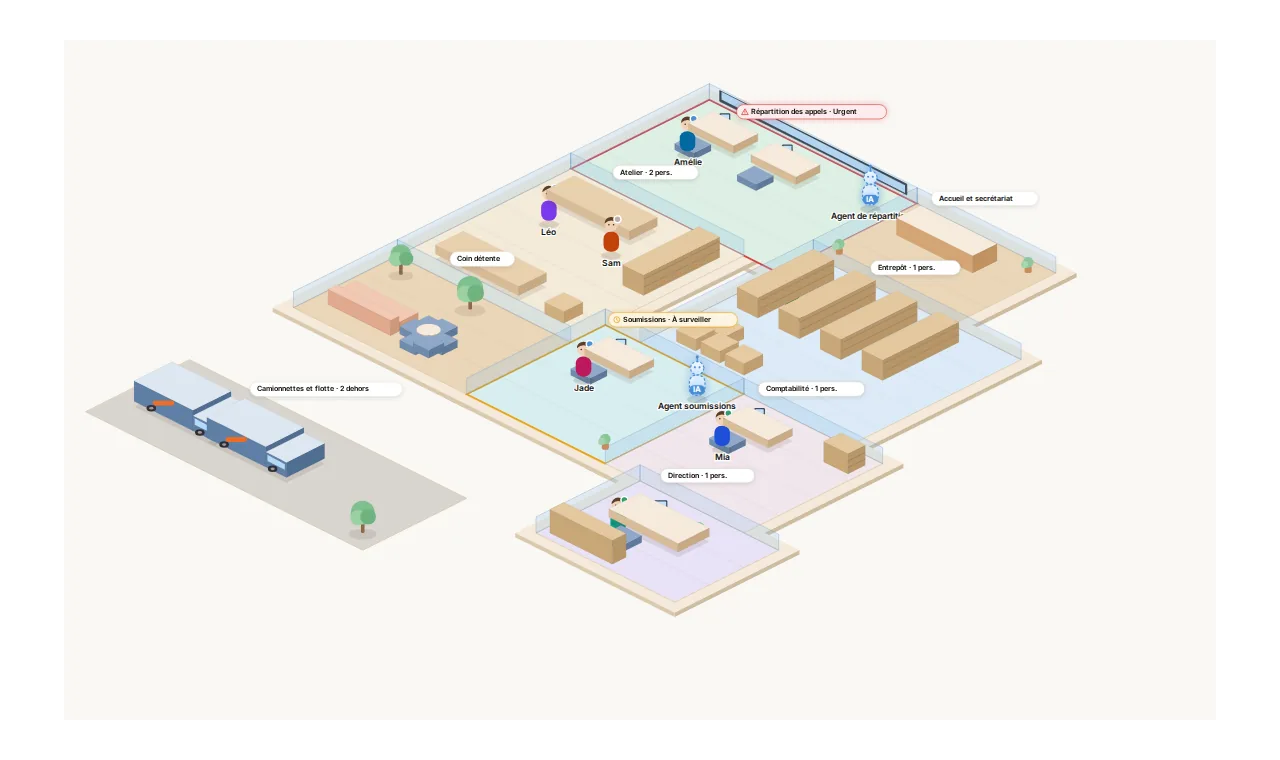
- Call answered
- Appointment confirmed
- Email reply ready
- Invoice prepared