
Cash flow: where does the money come from, and where does it go?
A business can be profitable and short of cash in the same month. Cash flow explains how.
Cash flow is the movement of money into and out of a business over a period. When more cash comes in than goes out, cash flow is positive; when the reverse happens, it is negative. Unlike profit, it follows money actually received and actually paid, at the moment it moves, which is why the two can tell very different stories.
30 days free, no credit card.
In short
- Net cash flow = cash in − cash out for the period.
- An invoice sent is not cash received; profit and cash flow can diverge.
- Profitable businesses can still have months of negative cash flow.
- BDC suggests tracking cash on hand, the cash conversion cycle and gross margin.
What does cash flow actually measure?
BDC describes cash flow as the movement of money in and out of a company, showing how much cash was generated and used during a given period. If more cash comes in than goes out, cash flow is positive; otherwise it is negative [1]. The Canadian accounting dictionary entry carried in Quebec's terminology bank puts it even more briefly: all cash inflows and outflows [3].
In conversation, “our cash flow” usually means the net figure: did the bank balance go up or down this month? Formal statements of cash flows then split that movement into operating, investing and financing activities.
Why is cash flow different from profit?
Profit matches revenue earned against expenses incurred; cash flow matches money received against money paid. They drift apart whenever there's a delay: an invoice paid in 45 days, a trailer bought outright, a deposit received before the work starts. BDC notes that even profitable businesses can go through short periods of negative cash flow, and that a business with negative cash flow over an extended period typically becomes insolvent [1].
| Transaction | Effect on this month's profit | Effect on this month's cash |
|---|---|---|
| $5,000 invoice issued, due in 30 days | +$5,000 revenue | $0 (not paid yet) |
| $12,000 trailer bought outright | Only this month's depreciation | −$12,000 |
| $2,000 deposit for June work | $0 (work not done yet) | +$2,000 |
| Principal repayment on a loan | $0 (only interest is an expense) | − the amount repaid |
Illustration only; exact accounting treatment is your accountant's call.
What does a cash forecast look like for a seasonal business?
Which indicators should you watch?
BDC recommends starting with monthly projections of expected inflows and outflows, then comparing them with actual results in a spreadsheet. It suggests three metrics for a cash flow dashboard: cash on hand against a target, the cash conversion cycle and gross profit [2].
The cash conversion cycle is days of inventory outstanding, plus days it takes customers to pay you, minus days you take to pay suppliers; the lower, the better [2]. A service business that carries little inventory mostly moves this number by getting its accounts receivable paid sooner.
Which habits put cash flow at risk?
- Treating invoiced revenue as money in the bank.
- Spending GST and QST collected, which must be remitted to government.
- Paying cash for equipment right before the tightest month of the year.
- Waiting until month-end to invoice work finished on the 3rd.
- Assuming that reaching break-even means the cash is there, without checking when customers will pay.
Does Pilotiko track cash flow?
No. Pilotiko doesn't connect to your bank statements and doesn't do accounting. Its internal reports show booking value at your service prices, and the software itself states that those amounts are never cash collected. They can still feed a forecast: the bookings scheduled for the coming weeks give a sense of work to be invoiced, and therefore of cash to come once payment terms are applied.
Frequently asked questions
How do you calculate monthly cash flow?
Add up all the money actually received during the month (customer payments, deposits, loan proceeds), then subtract all the money actually paid out (wages, suppliers, rent, loan repayments, tax remittances). That's net cash flow; add it to opening cash to get closing cash.
Can a profitable business run out of cash?
Yes. BDC points out that even profitable businesses can have short periods of negative cash flow. The usual culprits are slow-paying customers, big purchases paid in cash and a season that starts before the money does.
What is the difference between cash flow and net income?
Net income is what the business earned after all expenses, regardless of when money moves. Cash flow is the money that actually came in and went out. A sale on credit raises income right away but raises cash only when it's paid.
What does negative cash flow mean?
More money left the business than came in during the period. Occasionally that's normal, for instance at the start of a season. If it persists, the business is drawing down reserves or its credit line, and BDC warns that prolonged negative cash flow typically leads to insolvency.
How often should a small business forecast cash flow?
A 12-month forecast by month, reviewed monthly, suits most small service businesses. Some owners check cash on hand daily during tight months. What matters is comparing the forecast with actuals and fixing the assumptions.
Sources
- BDC, What is cash flow? (accessed on October 15, 2026).
- BDC, 3 key indicators for your cash flow dashboard (accessed on October 15, 2026).
- Office québécois de la langue française, flux de trésorerie (Grand dictionnaire terminologique) (accessed on October 15, 2026).
Read next
- Accounts receivable: how much do your customers owe you?Accounts receivable for a service business: aging buckets, days to collect and recovering GST on a bad debt, with an example from a Longueuil electrician.
- Break-even point: how much do you need to sell to stop losing money?The break-even point for a service business: overhead ÷ gross margin %, converting dollars into jobs per technician, and why BDC suggests working with a range.
- What is a management dashboard?What a management dashboard is, leading versus lagging indicators, how it differs from a report, a snow-removal example and mistakes that make it useless.
- What is revenue, and how do you calculate it?What revenue means for a small business: sales and services for a period, gross versus net, a GST and QST example for a Quebec service company, common mix-ups.
- Reports and steering: your numbers without a spreadsheetPilotiko reports: services, value, cancellations, new customers and staff workload over six periods. What they measure today, and what they do not measure yet.
- What is a KPI (key performance indicator)?What a KPI is, how to derive one from a business goal, formulas for a service company, a worked month of numbers and the traps to avoid when picking them.
Your whole business, on one screen.
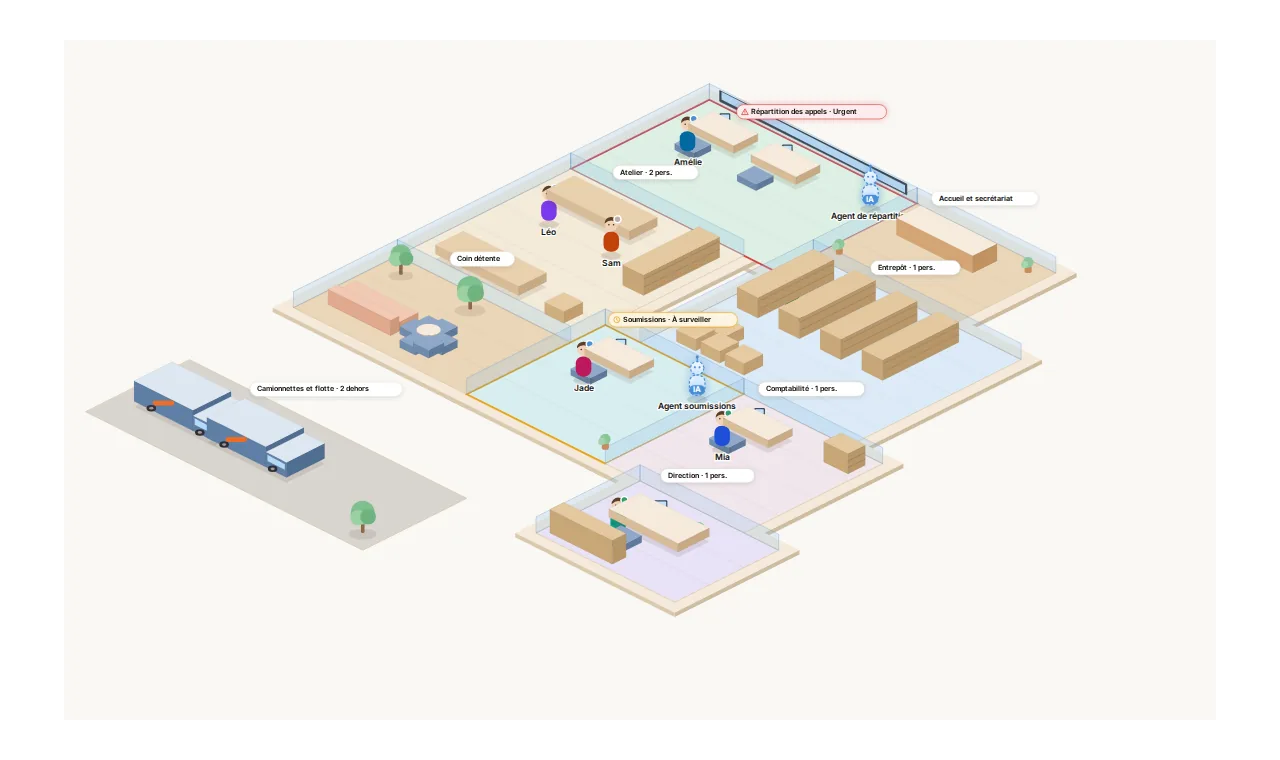
Each department is a room. Pilotiko prepares the work; you approve with one click.
- Call answered
- Appointment confirmed
- Email reply ready
- Invoice prepared