

Pilotiko feature : available
Break-even point: how much do you need to sell to stop losing money?
The level of activity where the business neither makes nor loses money, and beyond which every job counts.
The break-even point is the level of sales at which a business's revenue exactly covers all its costs, fixed and variable. Profit there is zero: below it you operate at a loss, above it you earn an operating profit. For most small businesses it is calculated by dividing overhead, the indirect costs, by the gross margin percentage.
30 days free, no credit card.
In short
- Break-even in dollars = overhead (fixed costs) ÷ gross margin %.
- Break-even in volume = break-even dollars ÷ average price per job or hour.
- Service businesses use the same formula, measured in hours or jobs instead of units.
- BDC recommends treating it as a range of scenarios rather than a single number.
What exactly does break-even mean?
BDC defines the break-even point as the level of sales at which a company's total revenue equals its total expenses. Below it you are operating at a loss; above it you are making an operating profit. In the words of one of its advisors, it is the minimum revenue you need so you don't lose money, but at that level you don't make any money either [1].
Terminology references add a useful nuance. The entry in Quebec's official terminology bank notes that break-even can be calculated for the whole company or for a single division, activity or service line, after the fact or as a forecast, in dollars or in quantities, and even to pinpoint the date when it will be reached [2]. That last use is the one seasonal businesses tend to find most practical.
Which formula works for a service business?
BDC's formula: break-even in dollars equals total indirect costs divided by the gross margin percentage. In its example, $25,000 of indirect costs and a 65% gross margin give a break-even of $38,461 in sales; at $10 a unit, that's 3,846 units [1].
BDC adds that service firms use exactly the same formula. The only difference is what you count: hours, for example, rather than units or products [1]. A field-service company can express its break-even in jobs, billable hours or contracts.
How many jobs a month does it take to break even?
Why work with a range instead of one number?
BDC suggests seeing break-even as a range, because revenue and costs both move. Its advisor's example: $250,000 of indirect costs at a 25% gross margin means $1 million in revenue to break even; if overhead trends toward $350,000, break-even climbs to $1.4 million. He recommends running the numbers at several overhead and margin levels [1].
| Monthly overhead | 40% margin | 45% margin | 50% margin |
|---|---|---|---|
| $16,000 | $40,000 (160 jobs) | $35,556 (143 jobs) | $32,000 (128 jobs) |
| $18,000 | $45,000 (180 jobs) | $40,000 (160 jobs) | $36,000 (144 jobs) |
| $20,000 | $50,000 (200 jobs) | $44,444 (178 jobs) | $40,000 (160 jobs) |
Pilotiko estimate: jobs rounded up, average price of $250.
How do you use break-even in day-to-day management?
Break-even becomes a key performance indicator once you translate it into a unit the crew sees every day: jobs per week, billable hours per technician. Put it on a dashboard and by the 15th of the month you know whether you're ahead or behind.
Hitting break-even does not mean there's money in the bank. A business that is profitable on paper can still run short if customers pay at 60 days; that's a cash flow question, tracked separately.
Which mistakes throw off a break-even calculation?
- Leaving the owner's pay out of overhead, so break-even looks low but nobody is paid.
- Dividing by the markup percentage instead of the gross margin percentage.
- Taking an annual figure and dividing by 12 in a highly seasonal trade.
- Adding a fixed cost, like a new truck or an office hire, without recalculating.
- Using tax-included prices as the average job value.
What does Pilotiko do to help track break-even?
Pilotiko does not calculate your break-even point, because it doesn't know your overhead. Its internal reports, available today, do count completed and scheduled bookings for the week or month, with their value at your service prices. Once you've set your break-even in jobs, you can compare actual volume with the volume you need at a glance.
Frequently asked questions
How do you calculate break-even for a service business?
Add up overhead for the period and divide by your gross margin percentage. With $18,000 of overhead and a 45% margin, break-even is $40,000 in sales. Divide by your average job price to express it as a number of jobs.
Is break-even the same as payback period?
No. Break-even is the sales level at which revenue covers costs in a period. Payback period is how long it takes for an investment, such as a new truck, to earn back what it cost.
Should the owner's salary be included in break-even?
It should. If the owner draws a regular salary, that amount belongs in overhead. Otherwise break-even only tells you the volume at which the business survives without paying the person running it.
What can you do if you're below break-even?
There are only a few levers: more volume, higher prices, lower direct costs to improve margin, or lower overhead. BDC recommends testing these scenarios before acting rather than cutting at random.
How often should break-even be recalculated?
Whenever fixed costs or prices change significantly, and at least once a year. BDC notes you may need to recalculate after a month or two if actual costs drift from the budget.
Sources
- BDC, What is break-even point? (accessed on October 15, 2026).
- Office québécois de la langue française, seuil de rentabilité (Grand dictionnaire terminologique) (accessed on October 15, 2026).
Read next
- Gross margin: what's left of a sale after direct costs?Gross margin for a service business: dollars versus percentage, which labour counts as a direct cost, a painting-contract example and the classic markup mix-up.
- Cash flow: where does the money come from, and where does it go?Cash flow explained: money in versus money out, why it differs from profit, a spring forecast for a Quebec landscaper and three indicators BDC suggests.
- What is a KPI (key performance indicator)?What a KPI is, how to derive one from a business goal, formulas for a service company, a worked month of numbers and the traps to avoid when picking them.
- What is a management dashboard?What a management dashboard is, leading versus lagging indicators, how it differs from a report, a snow-removal example and mistakes that make it useless.
- Reports and steering: your numbers without a spreadsheetPilotiko reports: services, value, cancellations, new customers and staff workload over six periods. What they measure today, and what they do not measure yet.
- SME: what is a small and medium-sized enterprise?What counts as an SME in Canada and Quebec: federal and Quebec definitions compared, the December 2024 Quebec figures and the classification mistakes to avoid.
Your whole business, on one screen.
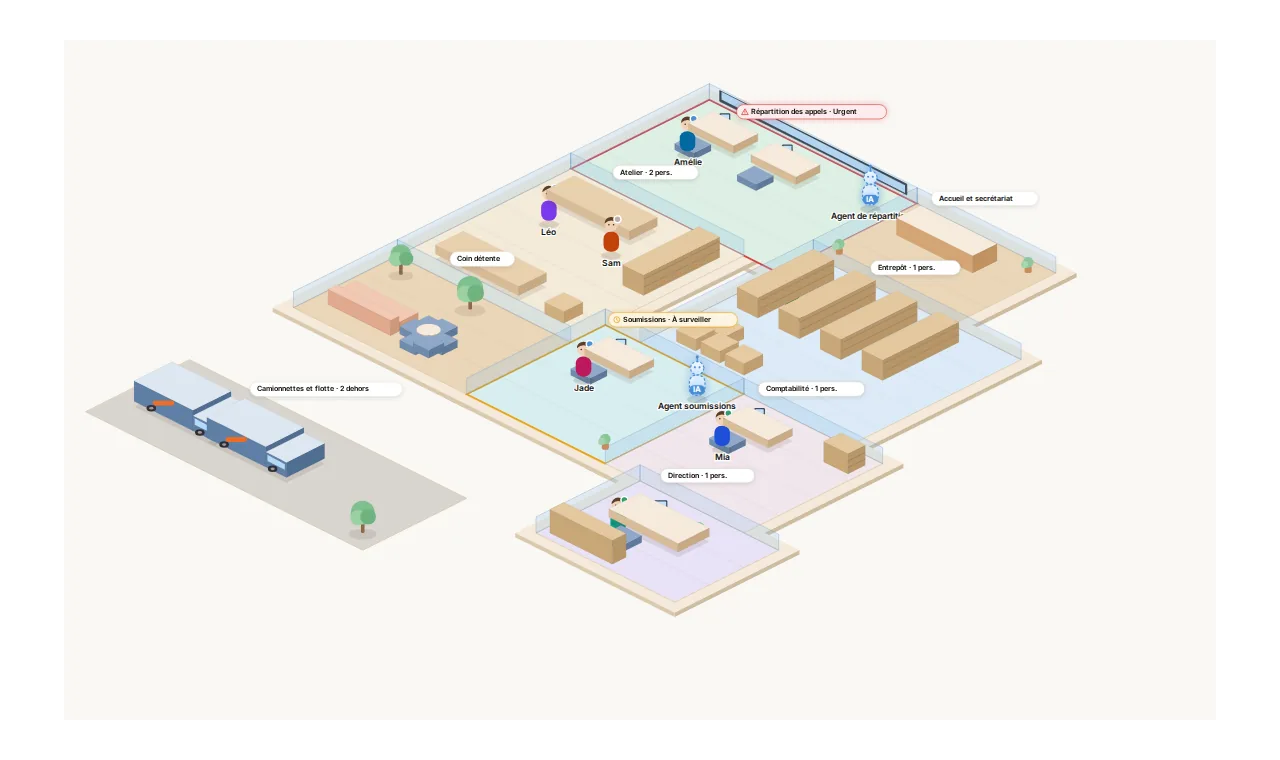
Each department is a room. Pilotiko prepares the work; you approve with one click.
- Call answered
- Appointment confirmed
- Email reply ready
- Invoice prepared