

Gross margin: what's left of a sale after direct costs?
The first floor of profitability, before rent, the office and advertising.
Gross margin is what remains of a sale, or of a period's revenue, once you subtract the direct costs of delivering it: materials, the labour that does the work and other job-specific costs. In dollars it is usually called gross profit; as a percentage of revenue it is the gross margin ratio that owners compare month to month.
30 days free, no credit card.
In short
- Gross profit = net revenue − cost of sales.
- Gross margin % = gross profit ÷ revenue × 100.
- In services, crew labour on the job is a direct cost; office staff are overhead.
- A negative gross margin means each sale costs more than it brings in.
Is gross margin a dollar amount or a percentage?
Both terms float around, so it helps to pin them down. BDC describes gross margin as the portion of revenue left over after you subtract direct costs such as labour and raw materials, and draws a clear line: gross profit is the dollar amount, gross margin is the percentage [1]. Its worked example: $1,100,000 in revenue less $730,000 in cost of goods sold leaves $370,000 of gross profit, a 33.6% gross margin [1].
Accounting dictionaries treat the terms as near-synonyms. The Canadian accounting dictionary entry reproduced by Quebec's language office defines gross margin as the excess of net sales over the cost of goods or products sold and lists gross profit and gross profit margin as English equivalents [3]. Whatever label you use, state whether you mean dollars or percent.
Which costs belong in a service company's calculation?
Direct costs are the ones that would not exist without the job: technicians' hours on site, materials, equipment rented for that contract, subcontractors. BDC notes that gross margin does not include indirect costs such as rent and marketing [2].
BDC also flags the most common mistake: booking all labour costs as cost of goods sold. Staff in marketing or the office aren't producing the service, and lumping them in understates gross margin and can lead to poor decisions [1].
| Expense | Where it goes | Why |
|---|---|---|
| Painters' hours on site | Direct cost | Varies with each job |
| Paint, primer, tape | Direct cost | Bought for the job |
| Scaffolding rented for one contract | Direct cost | Tied to that site |
| Dispatcher's salary | Overhead | Serves every job |
| Shop rent, insurance, advertising | Overhead | Exists even with no jobs |
Classification guidance based on BDC [1] [2]; your accountant has the final say for your statements.
How do you work out the gross margin on a painting job?
Why check gross margin every month?
BDC suggests most businesses calculate gross margin at least once a month instead of waiting for year-end statements [1]. In service work, margin is won or lost on hours: a job that runs past the estimate in your quote eats into margin while revenue stays exactly the same.
Comparing estimated hours with the actual hours recorded on each work order shows which kinds of jobs you price well. Gross margin then feeds your break-even point, which divides overhead by the gross margin percentage.
What mistakes do owners make with gross margin?
- Putting office salaries in direct costs, which flattens the margin.
- Calculating on tax-included prices; GST and QST are not your revenue.
- Confusing margin with markup: a 50% markup on cost is a 33.3% margin, not 50%.
- Changing how expenses are classified mid-year, which breaks comparisons.
- Looking only at the company-wide average and missing the jobs that lose money.
Does Pilotiko calculate gross margin?
No. Pilotiko isn't accounting software and doesn't receive your materials costs or payroll. Its internal reports, available today, show booking value at your service prices and the hours scheduled per staff member over a period. Those hours are a solid starting point for estimating direct labour; the margin itself comes from your accounting data.
Frequently asked questions
What is the gross margin formula?
Gross profit = net revenue − cost of sales. For the percentage, divide gross profit by revenue and multiply by 100. An $8,500 job with $5,300 in direct costs leaves $3,200, a 37.6% gross margin.
Are gross margin and gross profit the same thing?
They describe the same gap between sales and direct costs. BDC uses gross profit for the dollar figure and gross margin for the percentage. Just make sure everyone reading your numbers knows which one you mean.
Do wages count in gross margin?
Only the wages of people who deliver the work you sell, such as technicians on a job. Office, sales and marketing salaries are overhead. Mixing them in makes your margin look worse than it is.
What is the difference between gross margin and net margin?
Gross margin subtracts only direct costs. Net margin also subtracts overhead, interest, depreciation and taxes. A business can have a healthy gross margin and still lose money if overhead is too heavy.
What is a good gross margin for a service business?
There is no universal number; BDC notes that average gross margins vary widely by sector. Compare yourself with similar businesses and, above all, check that your margin covers overhead with something to spare.
Sources
- BDC, What is gross margin? (accessed on October 15, 2026).
- BDC, 3 key indicators for your cash flow dashboard (accessed on October 15, 2026).
- Office québécois de la langue française, marge brute (Grand dictionnaire terminologique, fiche ICCA) (accessed on October 15, 2026).
Read next
- Break-even point: how much do you need to sell to stop losing money?The break-even point for a service business: overhead ÷ gross margin %, converting dollars into jobs per technician, and why BDC suggests working with a range.
- What is revenue, and how do you calculate it?What revenue means for a small business: sales and services for a period, gross versus net, a GST and QST example for a Quebec service company, common mix-ups.
- Quote: what is a soumission in Quebec?What a quote, or soumission, means for Quebec service firms: the official sense, how binding an estimate is, a worked acceptance rate and mistakes to avoid.
- Work order: what should it include?What a work order is, what it should include, how it sits between the quote and the invoice, with a worked electrician example from Gatineau and common gaps.
- What is a KPI (key performance indicator)?What a KPI is, how to derive one from a business goal, formulas for a service company, a worked month of numbers and the traps to avoid when picking them.
- Reports and steering: your numbers without a spreadsheetPilotiko reports: services, value, cancellations, new customers and staff workload over six periods. What they measure today, and what they do not measure yet.
Your whole business, on one screen.
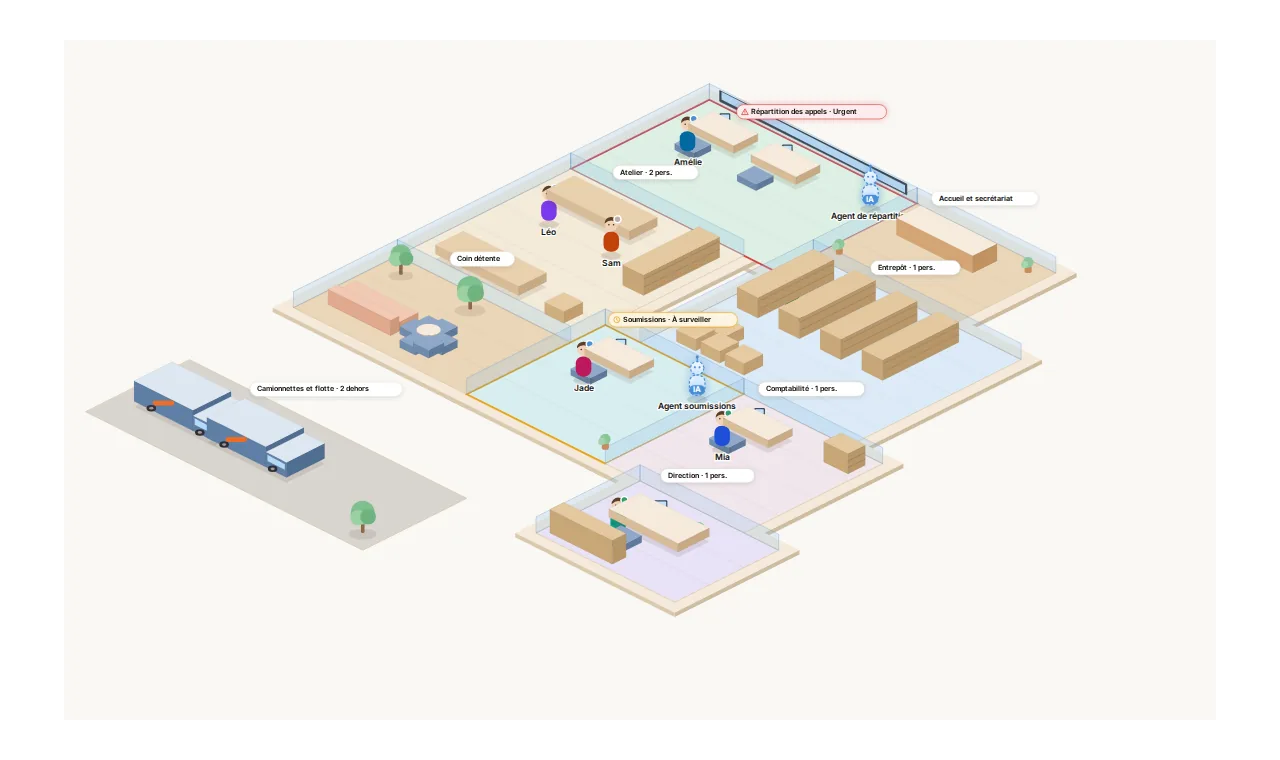
Each department is a room. Pilotiko prepares the work; you approve with one click.
- Call answered
- Appointment confirmed
- Email reply ready
- Invoice prepared