

Pilotiko feature : available
Long-tail keyword: why do specific searches matter?
Searches of five or six words: rare one by one, plentiful together.
A long-tail keyword is a long, specific search query, often four words or more, that few people type individually but that, added up with hundreds of similar queries, accounts for a large share of searches. It usually spells out a clear need, such as a service, a place and a constraint, which makes it easier to answer precisely.
In short
- “Long tail” describes the tail of a curve: many queries, each one infrequent.
- Google acknowledges long-tail queries are harder to visualize in performance data.
- Search Console shows them under the Queries tab of the Performance report.
- Stuffing a page with keyword variants goes against Google's spam policies.
Where does the phrase “long tail” come from?
Picture a chart. On the left, a handful of very popular searches (“plumber”, “movers”) form a tall head. To the right stretches a tail of thousands of rare searches like “replace 60 gallon water heater Saint-Jérôme Saturday”. Any one of them barely registers. Together they can outweigh the head.
Google uses the phrase itself: its guide to analyzing search performance admits that sites with many long-tail queries find them harder to visualize and understand, and suggests a bubble chart to sort them out [1].
How is a long-tail keyword different from a head term?
| Criterion | Head term | Long-tail keyword |
|---|---|---|
| Example | pest control | bed bug treatment apartment Longueuil |
| Word count | 1 to 2 | 4 or more |
| Need expressed | Vague | Specific: service, place, constraint |
| Competition | Heavy, often directories and big sites | Lighter, often specialised pages |
| Page that answers it | Home page or category page | Service page or FAQ section |
Word-count thresholds are an industry convention, not an official definition.
Why should a service business aim for the long tail?
A small local company rarely wins a one-word query it shares with the whole province. What it does have is first-hand knowledge of its customers' exact questions. Google's SEO Starter Guide makes the same point: think about the words people would use to find your content, keeping in mind that experts and newcomers search differently [2].
These queries tend to carry a sharp search intent. Someone typing “flat roof snow removal commercial Laval price” isn't browsing; they're comparing suppliers. The same kind of wording shows up in People Also Ask boxes.
How do you find your own long-tail queries?
Your own site is the best source. In Search Console's Performance report, the Queries tab groups data by the words people actually typed, with clicks, impressions, click-through rate and average position [3]. Sort by impressions, then scroll down: the tail starts where each query only earns a handful of impressions.
Bing Webmaster Tools also has a keyword research tool that, according to Microsoft, surfaces related queries and long-tail opportunities [4]. And write down the questions you hear on the phone or receive by email; they are your long tail before any report shows it.
How much does the long tail weigh on a small site?
Which long-tail mistakes should you avoid?
- Building one page per phrasing, which leaves you with near-identical pages competing with each other.
- Repeating the exact query in every paragraph; Google says keyword stuffing goes against its spam policies [2].
- Guessing at queries instead of reading the ones Search Console already shows.
- Dismissing low-volume queries because each one looks worthless on its own.
- Leaving related queries scattered instead of grouping them in a coherent topic cluster.
What does Pilotiko do with long-tail keywords?
Pilotiko's content drafting and editorial calendar are available today: an agent drafts pages or FAQ answers around your customers' specific questions, and nothing is published without your approval. To structure those answers, see the guide to writing an FAQ that shows up in Google or the FAQ generator. Pilotiko makes no ranking promise for any query.
Frequently asked questions
How many words make a long-tail keyword?
There's no official threshold. In practice people talk about the long tail from three or four words up, but what really matters is how rarely each query is searched on its own.
Do long-tail keywords convert better?
They often express a more specific need, so it's easier to match a page to them. No official source sets a long-tail conversion rate, though; measure it on your own site.
Where can I find my long-tail queries for free?
In Search Console's Performance report under Queries, and in Bing Webmaster Tools. Questions you receive by phone and email are another free and very reliable source.
Do I need one page per long-tail keyword?
No. One strong page can answer dozens of related queries. A page per variant tends to produce duplicate pages that compete with each other.
Does the long tail matter for AI search tools?
Questions people put to AI assistants are often long and detailed, much like long-tail queries. Pages that answer specific questions clearly are useful for both classic search and those tools.
Sources
- Google Search Central, Improve SEO with a bubble chart (accessed on October 15, 2026).
- Google Search Central, SEO Starter Guide (accessed on October 15, 2026).
- Search Console Help (Google), Performance report (Search results): overview and basic setup (accessed on October 15, 2026).
- Microsoft Bing Blog, Start Using Bing Webmaster Tools to Improve Your Site Visibility (accessed on October 15, 2026).
Read next
- Search intent: what does the searcher actually want?Search intent explained: the Know, Do, Website and Visit-in-person intents Google describes, a Quebec service-business example and the mistakes to avoid.
- Search Console impressions: what exactly gets counted?What a Search Console impression really counts: display rules, carousels, property versus page aggregation, and a seasonal example with figures.
- Local SEO: how do nearby customers find you?Local SEO explained: Google's relevance, distance and prominence factors, a service-area calculation for a Quebec small business, and costly mistakes.
- People Also Ask: what is that question box?Google's People Also Ask box explained: how it works, how to use it to pick topics, and a worked FAQ example for a Quebec service business with real numbers.
- Writing an FAQ that still pays off in Google and in AI answersFAQ rich results left Google in May 2026. Here's how to write an FAQ that still helps customers, earns snippets and feeds AI answers. A guide for SMBs.
- Topic cluster: how do you group your content by subject?Topic clusters explained: grouping pages and queries by broad subject around a pillar page. A 4-step method, a worked example and the mistakes to avoid.
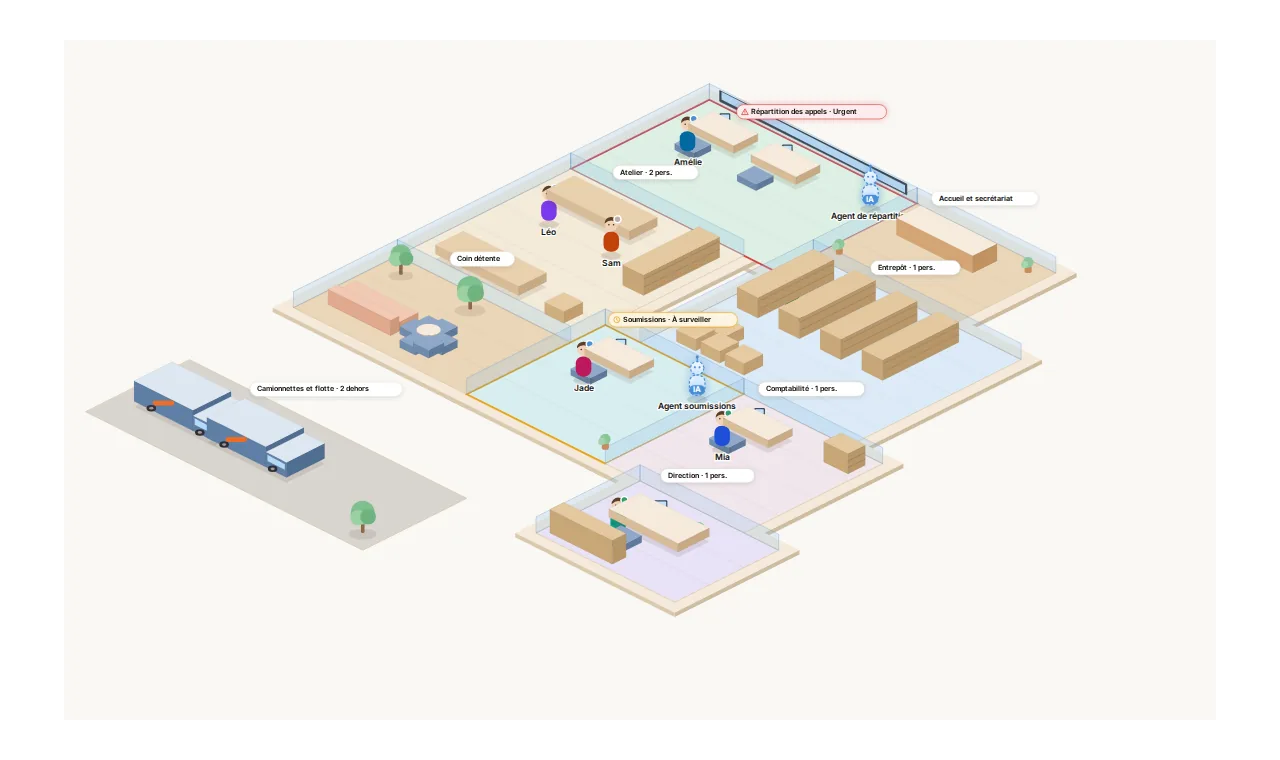
Your whole business, on one screen.
Each department is a room. Pilotiko prepares the work; you approve with one click.
- Call answered
- Appointment confirmed
- Email reply ready
- Invoice prepared