
Pilotiko feature : available
Open Graph: what shows up when someone shares a link to your site?
The title, image and summary on the card that appears when a customer pastes your address into a conversation.
Open Graph is a protocol of <meta property="og:…"> tags placed in a page's head to describe how the page should look when shared. Originally created at Facebook, it is read by LinkedIn, chat tools such as Slack and other services to build the link preview: title, image, description and the page's reference URL.
30 days free, no credit card.
In short
- Four properties are required on every page: og:title, og:type, og:image and og:url.
- og:description, og:site_name and og:locale are optional but recommended.
- LinkedIn asks for an image of at least 1200 × 627 pixels at a 1.91:1 ratio.
- A page that declares og:image should also declare og:image:alt.
- Google checks og:title among the sources for its title links.
Where does the Open Graph protocol come from?
According to ogp.me, the protocol was originally created at Facebook, drawing on Dublin Core, link rel=canonical and microformats among others, and the specification is published under the Open Web Foundation Agreement, version 0.9 [1]. The stated aim is to let any web page become a rich object in a social graph while giving developers a single thing to implement [1].
Under the hood it relies on RDFa: plain <meta> tags with a property attribute, added to the <head> [1]. They change nothing about how the page itself looks.
Which Open Graph tags should you add?
og:url should hold the object's canonical URL, used as its permanent ID [1], the same idea as a canonical tag. og:locale uses a language_TERRITORY format and defaults to en_US [1], so a Quebec business serving English-speaking customers would set en_CA, and fr_CA on its French pages.
| Property | Status per ogp.me | Sample content |
|---|---|---|
| og:title | Required | Residential Snow Removal in Lévis |
| og:type | Required | website |
| og:image | Required | Full URL of a photo of a snowblower at work |
| og:url | Required | The page's canonical URL |
| og:description | Optional, recommended | One or two sentences about the service |
| og:site_name | Optional, recommended | Business name |
| og:locale | Optional | en_CA (default is en_US) |
| og:image:alt | Expected whenever og:image is set | A description of the image, not a caption |
Source: ogp.me [1]. Sample content is fictional.
Which image works for the preview?
LinkedIn Help sets a minimum of 1200 pixels wide by 627 high for its sharing module, recommends a 1.91:1 ratio, and lists og:title, og:image, og:description and og:url among the tags that must exist [2]. ogp.me also defines og:image:width, og:image:height and og:image:type to describe the image, plus og:image:secure_url for an HTTPS copy [1].
Pick a real photo of your work or a clean brand image that still reads at thumbnail size. Then describe it in og:image:alt: ogp.me says a page that specifies og:image should specify og:image:alt too [1], the same thinking as alt text for on-page images.
What does a well-prepared preview look like?
Why won't the preview update?
Because platforms cache previews. Slack, for instance, explains that its link-expanding robot reads oEmbed, Twitter Card and Open Graph tags and caches the response across the service for around 30 minutes [3]. Large social networks have their own timing and inspection tools. After an edit, you may need to wait or ask the platform's tool to fetch the page again.
Slack also says it does not honour robots.txt for this purpose, since it acts on behalf of a person who pasted a link [3]. Blocking a bot in robots.txt is therefore not a dependable way to hide a preview.
Which Open Graph mistakes should you avoid?
- Skipping og:image, leaving the preview with a random picture or none at all.
- Using a relative image path; ogp.me's examples use a full URL [1].
- Repeating one og:title across every page, often just the business name.
- Leaving og:locale at its en_US default on pages written for Canadian customers [1].
- Uploading an image too small for LinkedIn's sharing format [2].
- Treating Open Graph as a substitute for the title tag or the meta description; it supplements them for sharing.
Does Open Graph help with Google SEO?
Not as a documented ranking signal, but Google lists the contents of og:title meta tags among the sources it examines when generating title links [4]. Open Graph's main job is still sharing: a link that looks right in a conversation gets opened more readily. To describe your business to search engines, structured data is the right tool.
What does Pilotiko do with Open Graph?
The site Pilotiko builds and hosts gets og:title, og:description, og:type, og:locale and og:site_name on every page, plus og:url when the canonical address is known and og:image when the site has a sharing image. The pre-publication check flags any page missing og:title. The audit of your current site reports an incomplete sharing preview (og:title or og:image missing on the home page). For your posts, see the LinkedIn and Facebook and Instagram integrations.
Frequently asked questions
Does Open Graph work outside Facebook?
Yes. LinkedIn requires these tags for sharing and Slack reads them to expand links. Other services use them too, each with its own display rules.
What size should og:image be?
LinkedIn asks for at least 1200 × 627 pixels at a 1.91:1 ratio. A 1200 × 630 image clears that minimum and stays close to the recommended ratio.
Does every page need Open Graph tags?
Yes, if it might be shared. Each page should carry its own og:title and og:url and ideally its own image; otherwise every share looks the same.
How is Open Graph different from Twitter Cards?
They are two separate vocabularies for describing a preview, and several services, Slack included, read both. A simple approach is to declare full Open Graph tags and add twitter:card to set the card format.
My preview still shows an old image. What now?
First check that og:image really points to the new file. Then wait for the platform's cache to expire or use its inspection tool to force a fresh read.
Sources
- ogp.me, The Open Graph protocol (accessed on October 15, 2026).
- LinkedIn Help, Make your website shareable on LinkedIn (accessed on October 15, 2026).
- Slack, Slack Robots (accessed on October 15, 2026).
- Google Search Central, Influencing title links in Google Search (accessed on October 15, 2026).
Read next
- Title tag: how should you name a page for Google and for customers?The title tag names each page for Google, the browser tab and screen readers. Recommended length, structure, a worked example and the mistakes to avoid.
- Meta description: what should appear under your page title on Google?A meta description suggests the summary Google may show under your title. How Google treats it, how to write one, a worked example and the pitfalls to skip.
- Alt text: how should you describe the images on your website?Alt text describes an image for screen-reader users and for Google. When to write it, when to leave it empty, a worked calculation and the most common slips.
- Canonical tag: how do you point Google to the right version of a page?A canonical tag tells Google which URL to prefer among duplicate pages. The methods, how strong each signal is, a worked URL count and the usual mistakes.
- Structured data: what are schema.org and JSON-LD?Structured data, schema.org and JSON-LD explained: formats Google accepts, a LocalBusiness markup example for a Quebec small business and the usual mistakes.
- LinkedIn and Pilotiko: publishing the posts you approveLinkedIn and Pilotiko: openid, profile and w_member_social scopes, text posts on the linked profile after your approval, and the connector's real status.
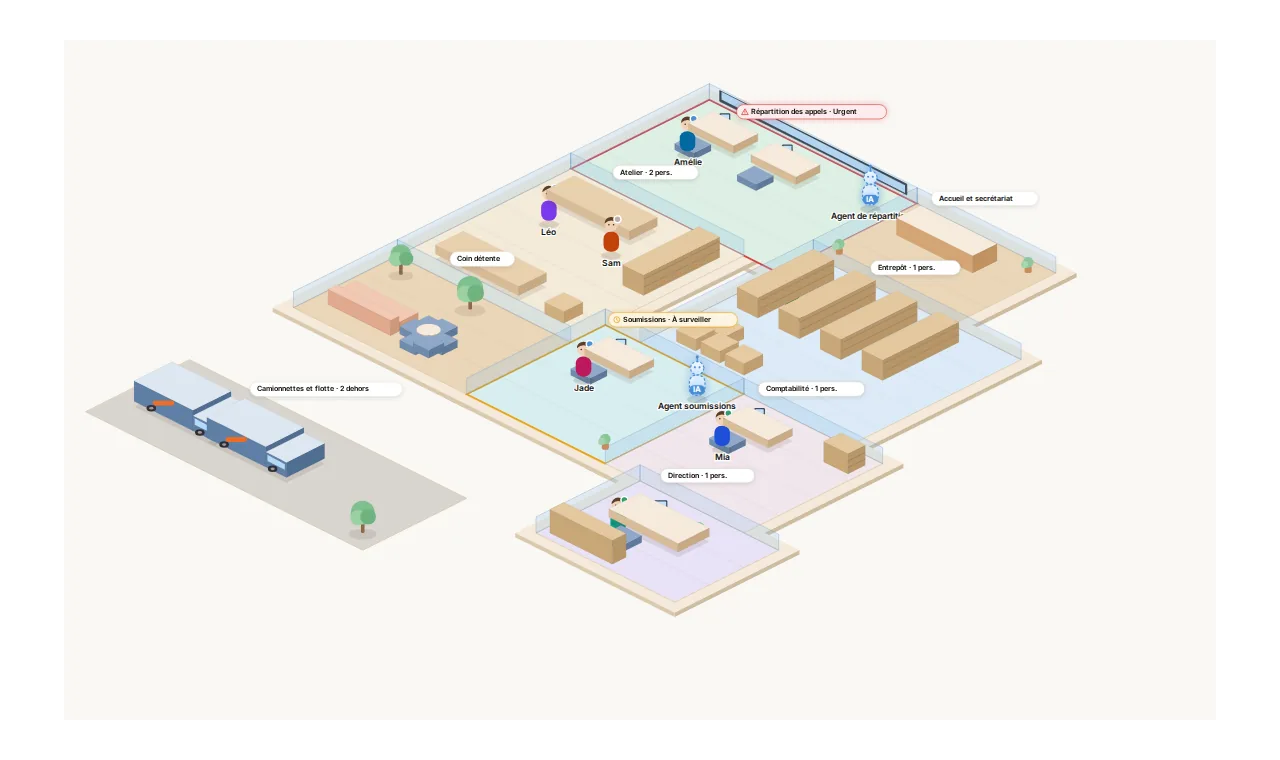
Your whole business, on one screen.
Each department is a room. Pilotiko prepares the work; you approve with one click.
- Call answered
- Appointment confirmed
- Email reply ready
- Invoice prepared