

Available
Your office sets itself up while you answer a few questions.
Pilotiko for psychology practices in Quebec
Same client, Tuesdays at 5 p.m., for six months: the recurring session is the backbone, and every exception matters.
Try 30 days freeSee the office in action
30 days free, no credit card.
Pilotiko helps a psychology practice manage recurring sessions, its waiting list and staff time off. Sessions are scheduled without overlaps, a freed-up slot shows up right away, and each new request is suggested to the clinician with room. No clinical notes and no reason for consultation are stored.
In short
- The main mission of the Ordre des psychologues du Québec is to protect the public [1].
- Psychologists, physicians, couple and family therapists and holders of a psychotherapist permit may practise psychotherapy [2].
- Professional secrecy covers confidential information learned in practice [3], so the reason for a visit doesn't belong on the schedule.
- Pilotiko sends automatic reminders.
How it works
- 1
Create your account
Your name, your email and a password. No credit card.
- 2
Answer a few questions
Pilotiko reads what is public about your business and only asks you for the rest.
- 3
Your office is ready
Your departments, tasks and dials, set up for your trade. Invite your team whenever you like.
A department for every part of your business
Leadership
Your whole business on one screen: red, orange, green, you know where to look.
Example: the late quote shows up in red.
Assistant and AI agents
They prepare the work from your real data; you approve.
Example: a customer follow-up drafted, ready to send in one click.
Appointments and schedules
Slots, assignments and the team calendar in one place.
Example: the technician free on Thursday is suggested for you.
Marketing
Your posts and editorial calendar prepared for you.
Example: this week's post, ready to approve.
Website and visibility
Get found on Google and by AI assistants.
Example: your service pages kept up to date with your real prices.
Reports and numbers
Your monthly numbers without a spreadsheet.
Example: this week's revenue compared with last week.
Phone reception
An AI receptionist that answers and offers an appointment.
Example: the 7 p.m. call becomes a confirmed appointment.
Learn more
6 sections · 6 min read
What makes a psychology practice's schedule different?
A psychology practice runs mostly on recurring sessions. Someone in therapy often keeps the same slot every week or every other week for months. The calendar is less a grid that fills up each morning than a set of commitments you protect, plus exceptions: a holiday, an illness, a change in the client's work hours.
Demand often outstrips supply. The waiting list grows, and when a slot opens you need to find the right person quickly based on need, approach and availability. Without a tool, that list lives in a spreadsheet nobody has time to open.
Summer makes it harder. Each clinician takes holidays, recurring sessions have to be paused and restarted, and requests keep coming in. Then September and January bring a fresh wave of new requests.
What rules apply to a psychology practice in Quebec?
The main mission of the Ordre des psychologues du Québec is to protect the public. Among other things, the Ordre says it ensures the quality of members' services and carries out more than 400 professional inspections every year [1].
Psychotherapy is a reserved activity. According to the Ordre, it may be practised by psychologists, couple and family therapists, physicians and holders of a psychotherapist permit, such as certain social workers, guidance counsellors, occupational therapists, nurses, psychoeducators, criminologists or sexologists; the law changed in 2012 [2]. A multidisciplinary practice therefore needs to know who offers what, and display it accurately.
Professional secrecy covers any confidential information learned in the course of practice [3]. Even the fact that someone is a client can be sensitive. Under Quebec's private-sector privacy act, medical or otherwise intimate information is sensitive, and using it for another purpose requires express consent [4]. Pilotiko is not a psychology records system, and we claim no profession-specific compliance for it.
| Information | Sensitivity | How Pilotiko treats it |
|---|---|---|
| Client name and contact details | Personal information | Kept for booking, with access limited to the team |
| Recurring slot (day, time, frequency) | Reveals that someone is a client | Visible only to authorized people at the practice |
| Reason for consultation, diagnosis, notes | Sensitive and under professional secrecy | No field for it: stays in your clinical record |
| Waiting-list preferences (times, online sessions) | Scheduling | List visible so a freed-up slot can be offered |
| Each clinician's caseload | Burnout prevention | Weekly report of sessions per person |
You control what your forms ask for. The rule of thumb is to ask for as little as possible.
How many sessions does a slow waiting list cost?
How does Pilotiko support a psychology practice?
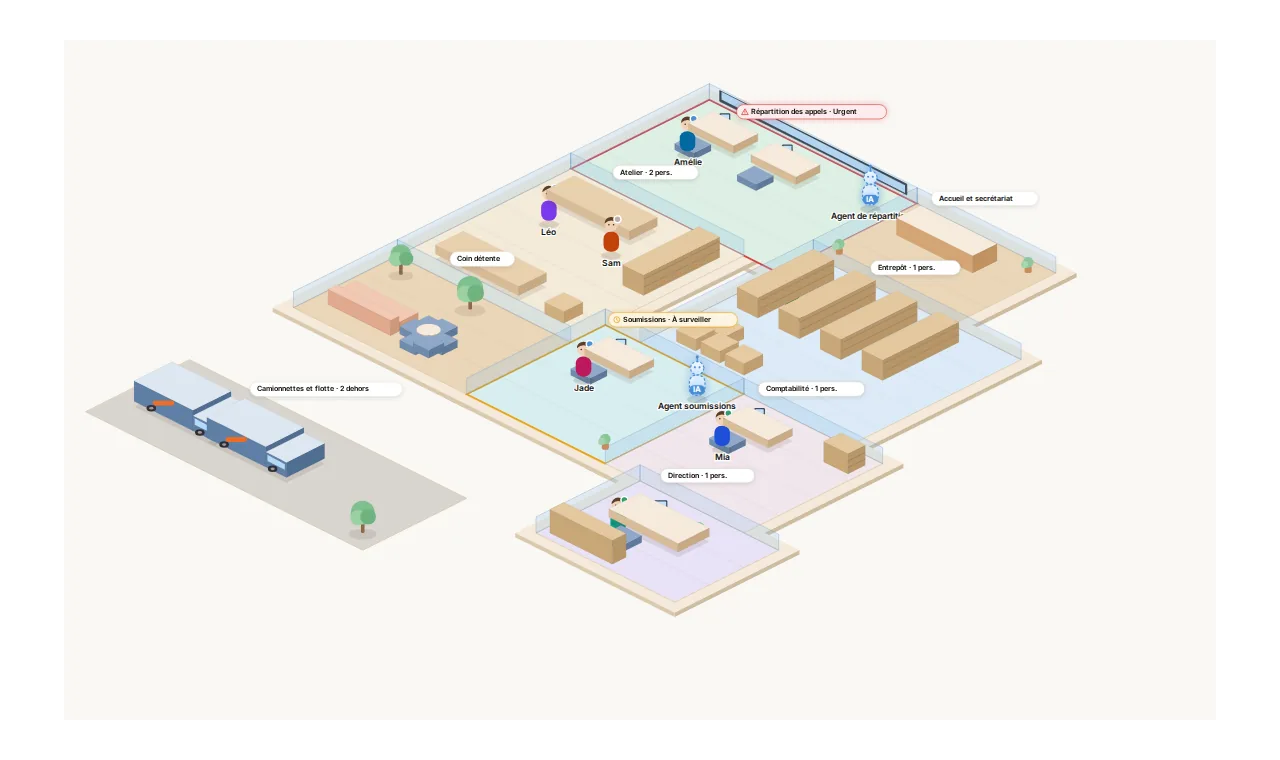
On the virtual office, the practice is divided into rooms: reception, offices, online sessions. A recurring slot that frees up shows at reception alongside the compatible people on the waiting list.
Recurring sessions are scheduled without overlaps, even when several clinicians share an office on certain days. You decide whether new clients can book a first meeting online or whether reception screens requests first. Scheduling accounts for everyone's time off.
For a new request, Pilotiko suggests the clinician with room and a reasonable caseload. Whoever handles intake confirms, taking each person's approach and permits into account.
- For remote sessions, the Zoom integration can create meeting links. Until then, you share your video link the way you do today.
- An AI agent can list the recurring sessions to pause while a clinician is on holiday; a person approves each change.
- The report shows sessions per person per week, which helps spot overload before it sets in.
What isn't available yet?
How do you protect confidentiality with a scheduling tool?
Don't ask for the reason for consultation on the booking form. A free-text field invites people to type intimate details that don't belong in a calendar. A simple choice between first meeting and follow-up is enough.
The law requires you to collect only the information needed for purposes set before collection, and consent must be given for specific purposes [4]. A privacy officer must be designated and their contact details published [5]. Our Law 25 guide and the Law 25 glossary entry explain these obligations.
Professional secrecy also shapes other practices: see our pages for notaries and law firms, and our explanation of human approval for AI agents.
Frequently asked questions
Is Pilotiko a records system for psychologists?
No. Pilotiko has no field for notes, reasons or diagnoses. It handles scheduling, the waiting list, offices and caseload alongside your records tool.
Can a session be booked every week at the same time?
Yes. You place the recurring session once; each occurrence can then be moved or paused without affecting the others.
What does a client see when booking online?
Only the meeting types you open and the free slots. You can limit online booking to existing clients and keep first meetings with reception.
Will text reminders mention psychology?
Pilotiko sends the automatic session reminders. The message template will be editable so it can stay neutral if the client wishes.
Can a multidisciplinary practice distinguish psychologists from psychotherapists?
Yes. Each clinician has a workstation, a title and meeting types. It's up to you to make sure displayed titles match each person's permit.
Does an AI agent read my clients' notes?
No. Agents work on the scheduling data Pilotiko holds; your clinical notes aren't there. Anything that touches a client waits for approval from someone at the practice.
Sources
- Ordre des psychologues du Québec, Mission (accessed on October 15, 2026).
- Ordre des psychologues du Québec, Qui pratique la psychothérapie? (accessed on October 15, 2026).
- LégisQuébec, Professional Code (CQLR, c. C-26), section 60.4 (accessed on October 15, 2026).
- LégisQuébec, Act respecting the protection of personal information in the private sector (CQLR, c. P-39.1), sections 4.1, 5, 12 and 14 (accessed on October 15, 2026).
- Commission d'accès à l'information du Québec, Principaux changements apportés par la Loi 25 (accessed on October 15, 2026).
Read next
- How to automate a service business in Quebec: the complete guideBookings, dispatch, follow-up, reminders, Law 25 and CASL: what a Quebec service business can automate, what should stay human, and where to start.
- Pilotiko for notary offices in QuebecFor Quebec notary offices: deed signings, signing rooms, witnesses and the late-June rush scheduled on one virtual office. Your records and deeds stay with you.
- Pilotiko for law firms in QuebecFor Quebec law firms: consultation requests, client meetings and lawyer workload on one virtual office. Pilotiko stays out of your files and trust account.
- Zoom and Pilotiko: scheduled meetings, checked and cleanly cancelledCreate, update and cancel Zoom meetings from Pilotiko with a waiting room: scopes requested, transcripts, what's still missing and the real status today.