

Available
Your office sets itself up while you answer a few questions.
Pilotiko for notary offices in Quebec
In late June, a notary office can run back-to-back deed signings with the same two rooms, the same witness and parties who show up late.
Try 30 days freeSee the office in action
30 days free, no credit card.
Pilotiko helps a notary office orchestrate signing appointments: signing rooms booked without conflicts, a witness reserved when one is needed, parties invited to slots that are genuinely open, and files spread between notaries and paralegals based on workload. Your records, deeds and legal files stay in your own tools.
In short
- In Quebec, a notary is a legal adviser and, unless retired, a public officer [1].
- Notaries keep the notarial acts en minute they execute in their records [1].
- A notarial will is entered in the Chambre des notaires' register of testamentary dispositions [2].
- Pilotiko is not legal practice management software: it schedules time, rooms and workload.
How it works
- 1
Create your account
Your name, your email and a password. No credit card.
- 2
Answer a few questions
Pilotiko reads what is public about your business and only asks you for the rest.
- 3
Your office is ready
Your departments, tasks and dials, set up for your trade. Invite your team whenever you like.
A department for every part of your business
Leadership
Your whole business on one screen: red, orange, green, you know where to look.
Example: the late quote shows up in red.
Assistant and AI agents
They prepare the work from your real data; you approve.
Example: a customer follow-up drafted, ready to send in one click.
Appointments and schedules
Slots, assignments and the team calendar in one place.
Example: the technician free on Thursday is suggested for you.
Marketing
Your posts and editorial calendar prepared for you.
Example: this week's post, ready to approve.
Website and visibility
Get found on Google and by AI assistants.
Example: your service pages kept up to date with your real prices.
Reports and numbers
Your monthly numbers without a spreadsheet.
Example: this week's revenue compared with last week.
Phone reception
An AI receptionist that answers and offers an appointment.
Example: the 7 p.m. call becomes a confirmed appointment.
Learn more
6 sections · 6 min read
Why does a notary office's calendar seize up?
A notarial signing brings several people to the same place at the same time: buyers, sellers, sometimes someone for the lender, the notary and, for some acts, a witness. If one party can't make it, everything moves, and the freed-up room sits empty.
Workload is very uneven over the year. Real estate transactions often bunch up in spring and late June, ahead of the July 1 moving day. Wills and protection mandates come in waves, often after news in the family. Estates arrive without warning.
Behind every signing there's preparation: checks, draft deeds, back-and-forth with the lender or broker. If the signing calendar isn't lined up with the paralegals' preparation load, the week turns into a bottleneck.
What rules apply to a notary office in Quebec?
Quebec's Notaries Act states that a notary is a legal adviser who takes part in the administration of justice and, unless retired, a public officer [1]. In that capacity, the notary's mission is to execute acts that parties wish or are required to give the authenticity attached to acts of public authority; the notary makes sure the parties give free and informed consent, advises them impartially, and keeps the notarial acts en minute they receive in their records [1].
The Act was amended in 2023. Among other things, it provides that acts en minute will have to be executed and kept on a technological medium according to a regulation; that provision was marked as not yet in force when we consulted it [1]. None of this runs through Pilotiko.
For notarial wills, the Government of Québec explains that they're made in the presence of a witness, generally provided by the notary, and sometimes a second one; that the notary keeps the original and must enter it in the Chambre des notaires' register; and that it doesn't need to be probated at death [2]. Notaries are also bound by professional secrecy under section 60.4 of the Professional Code [3].
| Appointment | What has to come together | What Pilotiko does today |
|---|---|---|
| Deed of sale and hypothec signing | Room, notary, all parties, file ready | Room booked without conflicts; slot suggested from the notary's calendar |
| Notarial will or protection mandate | Notary, witness, quiet room | The witness is a resource booked along with the room |
| First estate meeting | Long slot, several heirs | Appointment type with its own length, bookable online if you choose |
| Drafting the deeds | Paralegal time | Tasks visible per room; assignment suggested by workload |
| Deeds, minutes, index, ID documents | Notarial records and legal file | None: Pilotiko is not legal records software |
Pilotiko claims no compliance with the rules of the notarial profession.
How many room hours go to waste in late June?
How does Pilotiko organize a notary office?
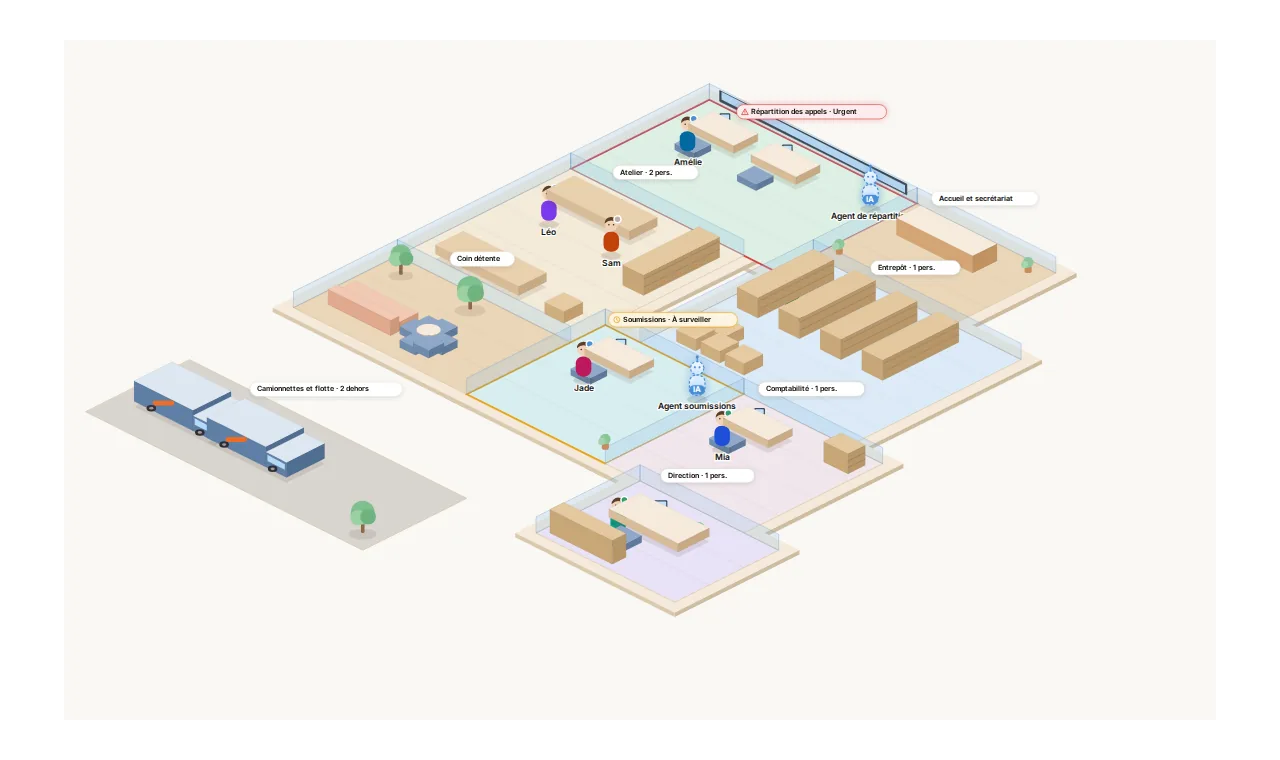
On the virtual office, the practice becomes a set of rooms: reception, real estate, estates, business law. A file waiting for a signing date shows up in the right room, next to everyone's workload.
Signing rooms and witnesses are resources: a signing can only be placed when the room, the notary and, if needed, the witness are free at the same time. Scheduling keeps an estate meeting from settling into the room set aside for a deed of sale.
For a new mandate, Pilotiko suggests the notary or paralegal with room that week. The coordinator confirms.
- An AI agent can list this week's signings still missing a scheduling element, such as a party who hasn't confirmed; someone at the office decides what to do.
- A weekly report shows signings held, moved, and workload per notary.
- Your office website, built and hosted by Pilotiko, explains what to bring to a signing and lists your practice areas, with structured data.
What isn't available yet?
How do you keep file details off the calendar?
The calendar only needs the appointment type, the people invited and their contact details. The property address, the price, ID numbers and the contents of a will stay in your file software and your notarial records.
Quebec's Law 25 covers clients' contact details, and the Commission d'accès à l'information reminds businesses that the person with the highest authority is responsible for protecting them [4]. Our Law 25 guide lays out the steps. Human approval applies too: an agent invites nobody without your say-so.
Real estate signings often depend on the work of real estate brokers and the tax calendar of accounting firms. For offices that share clients with a law firm, that page covers the issues specific to the Barreau.
Frequently asked questions
Does Pilotiko replace our notarial practice software?
No. Pilotiko drafts no deeds, keeps no records, index or minutes, and sends nothing to the land register. It schedules meetings, rooms, witnesses and workload.
Can a witness be booked together with the room?
Yes. The witness can be set up as a resource; a will appointment is only placed when the notary, the room and the witness are all free.
Can clients book a signing online?
Your choice. Most offices open first meetings online and keep signings with the coordinator, who checks the file is ready.
Can an AI agent invite parties to a signing?
It can draft the invitation and the list of people, but nothing is sent without approval from someone at the office. Pilotiko sends automatic email and text sending anyway.
Does Pilotiko handle the July 1 rush?
It shows which rooms and notaries are free and everyone's workload, which helps spread signings. It doesn't forecast volume: demand forecasting isn't built yet.
Does Pilotiko keep clients' ID documents?
No. The booking form doesn't ask for ID. Identity checks happen at the signing, following your own practices.
Sources
- LégisQuébec, Notaries Act (CQLR, c. N-3), sections 10, 11 and 35.1 (accessed on October 15, 2026).
- Government of Québec, Notarial will (accessed on October 15, 2026).
- LégisQuébec, Professional Code (CQLR, c. C-26), section 60.4 (accessed on October 15, 2026).
- Commission d'accès à l'information du Québec, Principaux changements apportés par la Loi 25 (accessed on October 15, 2026).
Read next
- How to automate a service business in Quebec: the complete guideBookings, dispatch, follow-up, reminders, Law 25 and CASL: what a Quebec service business can automate, what should stay human, and where to start.
- Pilotiko for law firms in QuebecFor Quebec law firms: consultation requests, client meetings and lawyer workload on one virtual office. Pilotiko stays out of your files and trust account.
- Pilotiko for real estate brokers and brokerage teamsFor Quebec real estate brokers and teams: showings, assistants, inspections and buyer follow-ups on one virtual office. What Pilotiko does for a team today.
- Pilotiko for accounting firms in QuebecFor Quebec accounting firms: T1 bookings, missing-slip follow-ups and CPA workload on one virtual office. See what Pilotiko does today, with no hype.