
Pilotiko feature : available
Service business software: CRM, ERP, SaaS or platform?
A guide to the main families of business software, which one fits a service company, and how they compare with hiring an agency or building an in-house team.
A CRM manages customer relationships, an ERP integrates every business function, and SaaS is a way of delivering software over the internet on a subscription. A service business mostly needs one tool that connects requests, bookings, crews, follow-up and numbers. Choose from your real workflow, not from the label.
30 days free, no credit card.
In short
- CRM (customer relationship management), ERP (enterprise resource planning) and SaaS (software as a service) answer different questions: SaaS describes delivery, not function.
- The core of a service business is request → booking → job → follow-up: check that the software covers it without re-entering data.
- In Quebec, software must be available in French when a French version exists, and an out-of-province vendor requires a privacy impact assessment.
- Software, agency or in-house team: compare on the work to be done, control and continuity, using your own numbers.
What does a service business need from management software?
A continuous thread between the customer's request, the booking, the person doing the job, the job report, the follow-up and the week's numbers. Every re-entry between two tools is a chance to forget something.
A company that sells products thinks in stock and orders. A service company thinks in hours, travel and skills. Its software has to answer concrete questions: who is free Thursday morning in the east end? Which quotes have waited a week for an answer? How much did each technician bring in this month?
Whether you search for small business software, service business software in Canada or a business management app for your phone, the need is the same: one place where information flows. Before you shop, sketch your typical workflow on paper. A request comes in by phone, email or web form. It becomes a quote or a booking. Someone is assigned. The job happens, a report is written, an invoice goes out, a follow-up is planned. Count how many tools touch that workflow today: a calendar, a spreadsheet, an inbox, accounting software. That is your starting point.
The guide Choose business management software offers a detailed selection grid. This pillar first explains the software families, so the grid compares like with like.
What is a CRM, and does a service business need one?
A CRM, or customer relationship management software, centralizes what the business knows about each customer in order to keep them. A service business needs one as soon as several people talk to the same customers.
Quebec's Office québécois de la langue française describes CRM software as a tool designed to help a business retain customers by bringing data on their needs and expectations into its information system. It notes that the software can be a stand-alone package or a module of an integrated management package [1].
For a service company, a useful CRM is not a twenty-stage sales funnel. It is the record that says: address, equipment, visit history, last quote, preferences. The technician arriving on site should see it on their phone. See the full definition in the glossary: CRM.
A free CRM can be enough at first. Before relying on one, check three limits on the vendor's official page: the number of users, data export, and what becomes paid as your team grows. The same check applies when you look for the best CRM in Canada or the best CRM for small business: the right answer depends on your workflow, not a ranking.
What is an ERP, and when does it make sense?
An ERP, or enterprise resource planning system, manages every business function in a single system. It makes sense when accounting, purchasing, inventory and payroll must share the same data.
The Grand dictionnaire terminologique defines the integrated management package, the French term for ERP, as software that manages a company's processes by integrating all of its functions, including human resources, accounting and finance, sales, distribution and purchasing [2].
That breadth is both a strength and a cost. An eight-person service company rarely uses warehouse management or production planning, yet it still pays for the configuration effort. ERP for small business makes most sense when the company carries a large parts inventory, runs several entities or has complex payroll. When comparing ERP software in Canada, also ask about French support and data location. The glossary entry ERP explains the vocabulary.
What is SaaS?
SaaS is a delivery model: the software runs on the vendor's side and you use it over the internet, usually on a subscription. A CRM and an ERP can both be offered as SaaS.
NIST, the US standards body, defines software as a service as the ability to use a provider's applications running on a cloud infrastructure. The customer does not manage the servers, network or storage, apart from a few settings specific to their account [3].
In French, the OQLF recommends the term logiciel-service and contrasts it with software installed on your own computers [4]. For SaaS for small business, the practical consequence is twofold: nothing to install or update, but a dependency on the vendor for access, security and data retention. That is why you need to know where data is hosted and how to get it back. See SaaS.
CRM, ERP, field service software or platform: which one?
Start from your bottleneck. Customers falling through the cracks: a CRM. Heavy accounting and inventory: an ERP. Bookings and crews on the road: field service management software. All of it without re-entry: an operations platform.
| Family | Question it answers | Strength | Common limit for a service business |
|---|---|---|---|
| CRM | What do we know about this customer? | History and sales follow-up | Scheduling and dispatch often missing or bolted on |
| ERP | How do all functions share data? | Accounting and financial integration | Heavy configuration for a small team |
| Field service management software | Who goes where, when, to do what? | Schedules, work orders, mobile use | Little sales follow-up or overall steering |
| Specialized tool (SEO, newsletter, payroll) | How do we do one task very well? | Depth of function | Isolated data, one more subscription |
| Operations platform | What is happening across the whole business? | One thread from request to numbers | Less depth than a specialized tool on each task |
Indicative classification proposed by Pilotiko. A single commercial product can belong to several families.
Software, agency or in-house team: how to compare?
Compare on the work to be done, not on the label. An agency brings judgement and experience, an in-house team knows the business, software brings continuity and speed. The three are often combined.
Many owners look for an alternative to a marketing agency or to a new hire. The right question is not which is cheaper, but what work must be done, how often, and who must stay in control.
The same logic applies between a specialized tool and a platform. A specialized SEO or newsletter tool goes deeper on its task. A platform links tasks together and avoids re-entry. If your problem is the depth of one function, the specialized tool often wins. If your problem is coordination, the platform has the edge.
To put numbers on the options with your own data, follow the method in Marketing and sales cost for a small business and in Calculate software ROI. This guide does not compare any named vendor.
| Criterion | Software | Agency | In-house team |
|---|---|---|---|
| Availability | Continuous, evenings included | Per the mandate | Per schedules and holidays |
| Knowledge of the business | What you give it | Built up over the mandate | Deepest |
| Judgement and creativity | Limited, needs supervision | Strong comparative experience | Depends on the people |
| Several tasks in parallel | Yes, without fatigue | Depends on the team assigned | Limited by headcount |
| Control and data | Yours, if export is planned | Shared, per contract | Yours |
Qualitative grid proposed by Pilotiko, with no cost figures: each situation is calculated with its own quotes and salaries.
Which software for a small business in Quebec and Canada?
There is no single best software for every small business. In Quebec, add three criteria to the features: French, where data is hosted, and portability.
French. Section 52.1 of the Charter of the French Language requires software to be available in French unless no French version exists [7]. For field crews, a French interface also reduces data-entry errors.
Hosting. Adopting new software that processes personal information is an information-system acquisition project: section 3.3 of Quebec's private-sector act calls for a privacy impact assessment. If data leaves Quebec, section 17 requires an assessment and a written agreement [6].
Portability. Since September 22, 2024, a person can obtain their computerized personal information in a structured, commonly used technological format [8]. Software that does not export cleanly makes that duty harder to meet.
Size. Innovation, Science and Economic Development Canada counts businesses with 1 to 99 paid employees as small and those with 100 to 499 as medium-sized [5]. Most service businesses are small: be wary of software designed for 500 people.
How do you decide between two options?
With a weighted grid: you choose the criteria, their weight and a score out of 5 for each option, then multiply. The total matters less than the gaps on the heavy criteria.
Where does Pilotiko fit among these families?
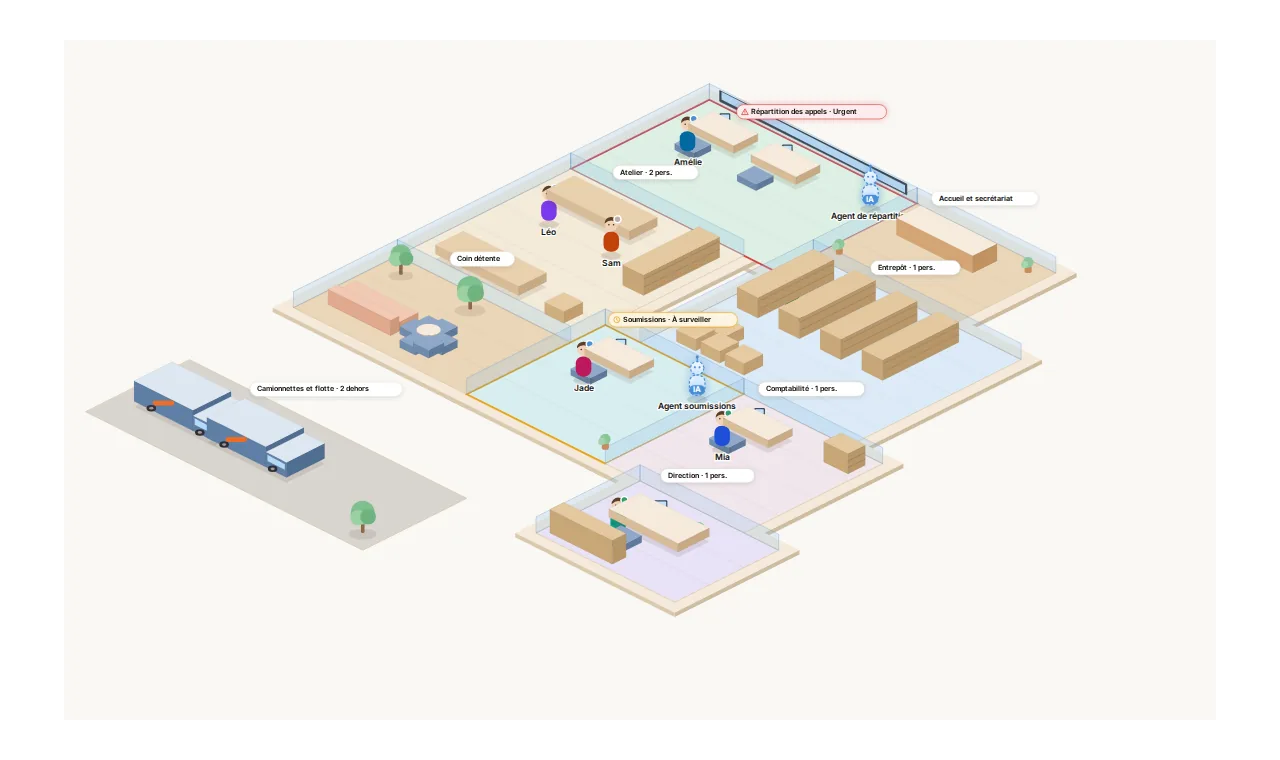
Pilotiko is an operations platform for service businesses: virtual office, booking and dispatch, reports, and AI agents with human approval. It is not a full ERP.
In Pilotiko, each department is a room in the virtual office, with its tasks and figures taken from real data. Online booking relies on real open slots, and assignment is proposed from calendars and workload. Internal reports cover bookings, revenue and workload. AI agents prepare the work; a person approves anything touching a customer, money or a send.
Pilotiko also builds and hosts the company website. Pilotiko sends email and SMS confirmations and reminders. For AI itself, read AI for service businesses; for the numbers, Revenue dashboard for a service business.
Frequently asked questions
What is a CRM, in plain terms?
It is the software that keeps everything the business knows about its customers: contact details, history, quotes, preferences. It exists so nothing gets forgotten and customers come back.
What is the difference between a CRM and an ERP?
A CRM focuses on customer relationships. An ERP integrates every business function, including accounting, purchasing and payroll. A CRM can even be one module of an ERP.
Is SaaS a type of software?
No, it is a delivery model. The software runs on the vendor's side and you reach it over the internet, often on a subscription. A CRM, an ERP or a platform can all be offered as SaaS.
Is a free CRM enough for a small service business?
Sometimes, at the start. Check the number of users allowed, whether you can export your data and what becomes paid. A free CRM rarely handles scheduling and technician dispatch.
Can software replace a marketing agency?
It can handle part of the work continuously, such as drafting, scheduling and measuring. An agency brings judgement and comparative experience. The right choice depends on the work to be done and how much control you want to keep.
Does my business software have to be in French in Quebec?
Under section 52.1 of the Charter of the French Language, software must be available in French unless no French version exists. Also check that documents sent to customers are in French.
Can I use software hosted outside Quebec?
Yes, provided you complete a privacy impact assessment and sign a written agreement with the vendor, as section 17 of Quebec's private-sector act requires. Ask where the servers and backups are located.
Sources
- Office québécois de la langue française (Vitrine linguistique), logiciel de gestion de la relation client (GDT) (accessed on October 15, 2026).
- Office québécois de la langue française (Vitrine linguistique), progiciel de gestion intégré (GDT) (accessed on October 15, 2026).
- NIST, SP 800-145, The NIST Definition of Cloud Computing (accessed on October 15, 2026).
- Office québécois de la langue française (Vitrine linguistique), logiciel-service (GDT) (accessed on October 15, 2026).
- Innovation, Science and Economic Development Canada, Key Small Business Statistics 2025 (accessed on October 15, 2026).
- LégisQuébec, Act respecting the protection of personal information in the private sector (CQLR, c. P-39.1) (accessed on October 15, 2026).
- LégisQuébec, Gouvernement du Québec, Charter of the French Language (CQLR, c. C-11), s. 52.1 (accessed on October 15, 2026).
- Commission d'accès à l'information du Québec, Principaux changements apportés par la Loi 25 (accessed on October 15, 2026).
Read next
- AI for small service businesses: assistants, agents and platformsAI assistant, AI agent or AI platform: what artificial intelligence really does for a small service business in Canada, the risks, and where to start.
- Revenue for a service business: definition, calculation and dashboardDefinition, calculation with or without sales tax, dashboard and levers: how a small service business in Canada measures, tracks and grows its revenue.
- How to choose business management software for a service companyWeighted scoring, vendor questions, Law 25, data hosting and portability: a practical method for choosing management software for a Quebec service business.
- What is CRM (customer relationship management)?What CRM means, what CRM software actually holds, a follow-up calculation for a Quebec service business, and the privacy duties Quebec's Law 25 adds.
- What is an ERP (enterprise resource planning) system?What an ERP system is, what it integrates, a double-entry calculation for a Quebec service company, and the classic mistakes of a first ERP project.
- What is SaaS (software as a service)?What SaaS means, how it differs from installed software, a three-year subscription calculation for a Quebec service SME and the contract traps to avoid.
Your whole business, on one screen.
Each department is a room. Pilotiko prepares the work; you approve with one click.
- Call answered
- Appointment confirmed
- Email reply ready
- Invoice prepared