
Pilotiko feature : available
AI for small service businesses: assistants, agents and platforms
A guide for owners of service businesses who want to put artificial intelligence to work on real tasks without losing control of what reaches their customers.
For a service business, AI mostly reads your company data and prepares work: replies to customers, visit summaries, proposed schedules and reports. An AI agent chains those steps together using tools. A person still approves every outgoing message, price or refund. Start with one measured task, then add the next one.
30 days free, no credit card.
In short
- An AI assistant answers a request; an AI agent completes a multi-step task using tools; an AI platform connects both to your real data.
- In Canada, 25.2% of businesses planned to use AI in the third quarter of 2026, up from 14.5% a year earlier (Statistics Canada).
- The main risk with an agent is not a typo but one action too many: give it the fewest permissions possible.
- Quebec's Law 25 and CASL apply as soon as AI handles personal information or prepares commercial messages.
What can AI actually do in a service business?
It reads, summarizes, sorts and drafts from your data. In a service business, that mostly means answering requests, preparing jobs, following up and reporting.
A service business sells skilled time: a repair, a cleaning, a consultation, an inspection. Around that time sits a steady stream of small writing jobs. Reply to a quote request. Summarize what was done on site. Find the right slot. Prepare Monday's report. These are reading and writing tasks, which is exactly what language models handle well.
What AI cannot do is know your trade for you. It does not know that one customer always asks for the same technician, or that roofing waits when it rains, until those rules are written down somewhere it can read them. Output quality depends first on the quality of your data.
This guide covers AI applied to day-to-day operations. Business process automation, where software applies a fixed rule to every request, is the other half of the answer to the question how do I automate my business: read How to automate a service business. For choosing the software itself, see Service business software.
AI assistant, AI agent, AI platform: what is the difference?
An assistant answers a request; an agent pursues a goal over several steps and uses tools; a platform provides the data, tools and safeguards the agent needs.
Quebec's Ministry of Cybersecurity and Digital Technology describes agentic AI as systems that can pursue a goal, orchestrate steps and use tools within a defined scope. It stresses that their effects go beyond the content they produce: they also involve access, actions and costs [2]. That difference is what matters for a small business.
A general chat assistant cannot see your calendar. An agent connected to your calendar can propose a time, and an agent with write access can change it. The more access an agent has, the more useful it is, and the more an error costs. The glossary entry AI agent goes deeper.
| Form | What it sees | What it does | Main risk |
|---|---|---|---|
| General AI assistant | Whatever you paste into it | Answers, drafts, summarizes | Customer data pasted into the tool |
| AI agent | The sources and tools you open to it | Chains steps toward a goal | One action too many, or the wrong one |
| Business AI platform | Your real data, filtered by role | Runs agents under rules and a log | Badly set permissions |
Classification proposed by Pilotiko for this guide, based on the distinction in Quebec's guide on agentic AI [2].
Are Canadian businesses really adopting AI?
Intentions are rising fast. In the third quarter of 2026, 25.2% of businesses in Canada planned to use AI over the next 12 months, compared with 10.6% two years earlier.
According to the analysis Statistics Canada released on October 1, 2026, the share of businesses planning to use AI to produce goods or deliver services rose from 10.6% in the third quarter of 2024 to 14.5% in the third quarter of 2025, then to 25.2% in the third quarter of 2026 [1].
Among businesses with 20 to 99 employees, the share more than doubled in one year, from 15.0% to 32.8% [1]. That size band looks a lot like service companies coordinating several crews. Keep in mind these are stated plans, not measured use or proven gains.
Which AI uses pay off most in a service business?
The ones that come up often, start from data already in your systems, and can be checked in seconds: draft replies, summaries, proposed assignments and reports.
Score every idea with three questions. How many times a week? Does the data already exist? Can someone check the result at a glance? A use that gets three yeses is a good first project. The table also shows the real status of each use in Pilotiko.
| Use | Data needed | How it is checked | In Pilotiko |
|---|---|---|---|
| Draft reply to a customer request | Customer record, services, availability | Read before sending | Available: the agent prepares, a person approves |
| Job summary | Technician notes, file | Quick read | Available (AI agents) |
| Proposed assignment | Calendars, workload | One click to accept or correct | Available |
| Weekly report | Bookings, revenue, workload | Compare with last week | Available |
| Drafting social posts | Services, seasons, company tone | Approval before posting | Available, including LinkedIn publishing |
| Appointment reminders | Calendar, contact details | Fixed template | Available: sent by Pilotiko |
| Answering the phone | Calendar, services, areas | Listening to calls | Coming soon |
| Prospecting new customers | Lists, consents | Review of every message | Available |
Statuses come from Pilotiko's capability register. Available means built and tested, usable today.
Can you automate marketing and sales with AI?
Partly. AI is very good at preparing copy, follow-ups and call lists. Sending is governed by CASL and should stay under a person's control.
Marketing automation and sales automation often promise sequences that run on their own. In a service business, the useful version is more modest: AI drafts the follow-up on an unanswered quote, proposes the spring newsletter, or lists customers whose annual maintenance is due. A person decides what goes out.
Canada's Anti-Spam Legislation prohibits sending a commercial electronic message without consent, and every message must identify the sender, give contact details and offer a way to unsubscribe [6]. AI that writes faster does not change those duties; it only increases the number of messages to review.
What you can track today: the number of quotes without follow-up and the average time to answer a request. Both belong on a dashboard, as explained in Revenue dashboard for a service business.
What are the risks of an AI agent for a small business?
Inventing a plausible detail, leaking personal information and, above all, excessive action: an agent that can do more than it needs will eventually do it at the wrong moment.
The OWASP Gen AI Security Project calls this risk excessive agency. It lists three root causes: too much functionality given to the agent, too many permissions, or too much autonomy to act without checks [3]. The fix is simple to state: an agent that drafts replies does not need permission to delete customers.
In Canada, the Voluntary Code of Conduct on advanced generative AI from Innovation, Science and Economic Development Canada includes human oversight and monitoring among its principles [4]. In Quebec, section 12.1 of the private-sector privacy act requires informing a person when a decision about them is based exclusively on automated processing [5].
The guide Human approval for AI agents offers a grid by type of action, and Quebec's Law 25 for service businesses covers the assessments to complete before adopting a tool.
- Read before write: start with agents that look up and prepare, without permission to change records.
- One approval per send: every customer message, price and refund waits for a person's go-ahead.
- A log: every proposed and approved action leaves a trace you can review.
- Roles: the agent only sees what the person using it is allowed to see.
How much time can an AI agent free up?
It depends on volume and on how long drafting takes today. The example below shows the method; replace the assumptions with your own measurements.
How do you choose an AI platform for your business?
Check five things: access to your real data, permission controls, human approval, hosting location and the ability to export. The feature list comes after.
- Your data, not a demo. Ask to see the agent work on a copy of your typical week.
- Permissions by role. A team member must not get through the agent what they cannot see otherwise.
- Configurable approval. You decide which actions run alone and which wait for a go-ahead.
- Hosting and Law 25. Section 17 of Quebec's private-sector act requires an assessment and a written agreement before personal information is communicated outside Quebec [5].
- A way out. Your data must be exportable in a common format if you switch tools.
Where should a service business start with AI?
With a read-only use that is frequent and easy to check, measured over four weeks. Write permissions come only once trust is established.
- 1
List ten writing tasks
For one week, note every text you write: replies, summaries, follow-ups, reports, with the time spent.
- 2
Pick the most frequent one
Choose the one that comes up most and where a mistake costs little, often the draft reply or the job summary.
- 3
Write down your trade rules
Services, durations, areas, exceptions: what the agent must know and no tool can guess.
- 4
Set the approvals
Decide who approves what before the first use.
- 5
Measure and adjust
Compare time spent and number of corrections after four weeks, then move to the next use.
What does Pilotiko do with AI today?
In Pilotiko, an assistant reads the company's real data, prepares actions and only carries them out after confirmation. AI agents, the virtual office, scheduling and reports are available.
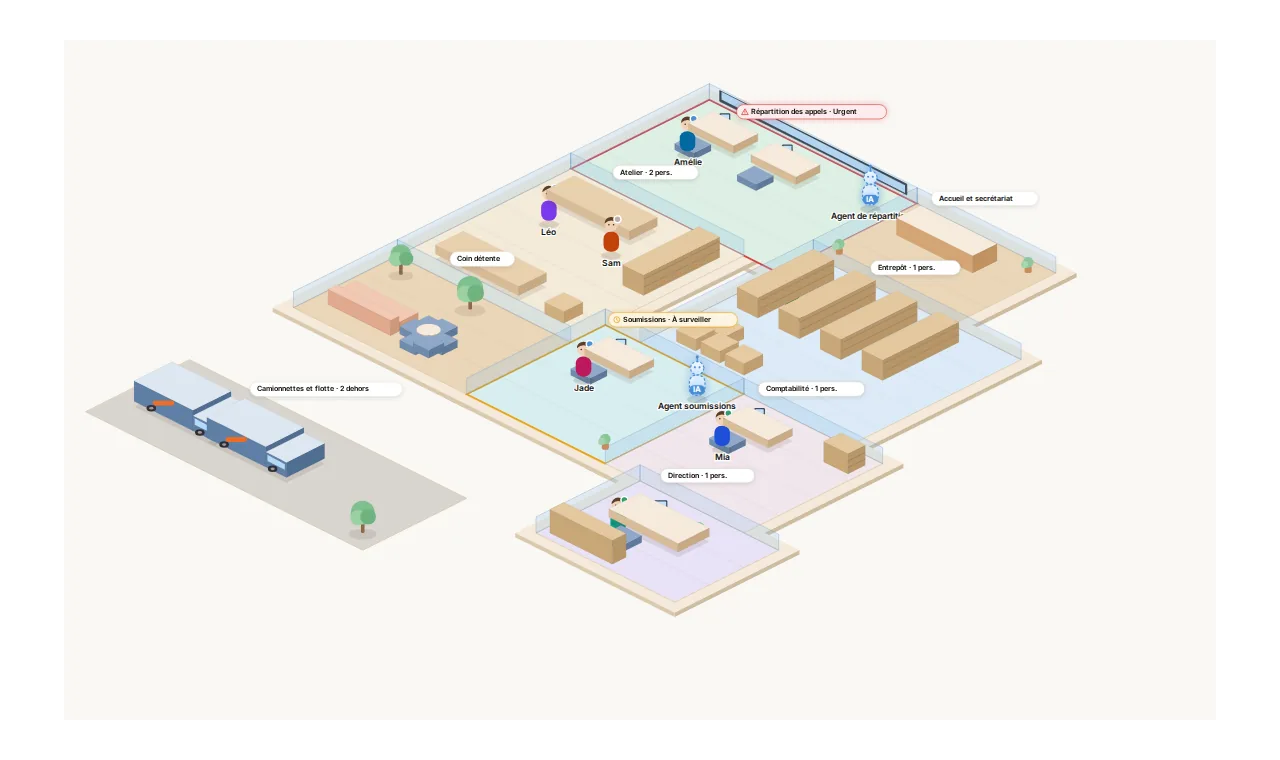
Pilotiko is an operations platform: AI agents read calendars, files and reports according to each person's role, and prepare the work. Anything touching a customer, money or a send waits for a person's approval. The virtual office shows each department as a room, with what is waiting for a decision.
Pilotiko sends confirmations and reminders. The AI phone receptionist, email marketing, prospecting, route optimisation and demand forecasting are still to come.
Frequently asked questions
What is the difference between an AI assistant and an AI agent?
An assistant answers one request at a time from what you give it. An agent pursues a goal over several steps and uses tools such as your calendar or customer files. The agent is more useful, but it needs well-set permissions and approvals.
Is AI for small business worth it with fewer than 10 employees?
Yes, if the owner spends a lot of time writing: quotes, replies, reports. Size matters less than the volume of repetitive tasks. Measure your writing hours over one week first.
Can I paste customer information into a free AI assistant?
Be careful. Check where the tool stores data and whether it reuses it. Quebec's Law 25 makes you responsible for the personal information you hold, and section 17 governs sending it outside Quebec.
Can an AI agent email my customers on its own?
Technically yes; it is not recommended. A wrong message cannot be recalled, and CASL requires consent, identification and an unsubscribe mechanism for commercial messages. In Pilotiko, the agent prepares and a person approves.
Will AI replace my staff?
In a service business, AI mostly removes writing and coordination time. On-site work, judgement and customer relationships stay human. Think of it as equivalent capacity freed up, not jobs cut.
How much does an AI platform for business cost?
Pricing models vary: per user, per company or by usage. Compare the total cost with the time actually freed up, measured on your own tasks. Ask for a written price that includes AI usage, not just licences.
Do I need technical skills to use an AI agent?
Not for daily use, if the platform is well designed. What you need is the ability to describe your trade rules and decide who approves what. Setting up access takes attention, not an IT specialist.
Sources
- Statistics Canada, Analysis on planned use of artificial intelligence by businesses in Canada, third quarter of 2026 (accessed on October 15, 2026).
- Ministère de la Cybersécurité et du Numérique (Gouvernement du Québec), Guide sur l'utilisation responsable de l'intelligence artificielle agentique (accessed on October 15, 2026).
- OWASP Gen AI Security Project, LLM06:2025 Excessive Agency (accessed on October 15, 2026).
- Innovation, Science and Economic Development Canada, Voluntary Code of Conduct on the Responsible Development and Management of Advanced Generative AI Systems (septembre 2023) (accessed on October 15, 2026).
- LégisQuébec, Act respecting the protection of personal information in the private sector (CQLR, c. P-39.1) (accessed on October 15, 2026).
- Justice Laws (Justice Canada), Canada's Anti-Spam Legislation (S.C. 2010, c. 23), sections 1 to 9 (accessed on October 15, 2026).
Read next
- Service business software: CRM, ERP, SaaS or platform?CRM, ERP, SaaS or an operations platform: what each kind of small business software does for a service company in Canada, its limits, and how to choose.
- Revenue for a service business: definition, calculation and dashboardDefinition, calculation with or without sales tax, dashboard and levers: how a small service business in Canada measures, tracks and grows its revenue.
- How to automate a service business in Quebec: the complete guideBookings, dispatch, follow-up, reminders, Law 25 and CASL: what a Quebec service business can automate, what should stay human, and where to start.
- Human approval for AI agents: what a small business should sign off onWhich AI agent actions need sign-off, how to rank the risk, what Law 25 and Canada's AI code say, and how long review really takes in a small service business.
- What is an AI agent?An AI agent pursues a goal by chaining steps and tools on its own. Definition, the agent loop, a worked example for a Quebec SME and the guardrails it needs.
- Quebec's Law 25: what a service business must do, section by sectionPrivacy officer, consent, vendors, incidents, retention and penalties: Quebec's Law 25 explained section by section for small service businesses in Quebec.
Your whole business, on one screen.
Each department is a room. Pilotiko prepares the work; you approve with one click.
- Call answered
- Appointment confirmed
- Email reply ready
- Invoice prepared